Introduction: Beyond Laughing Matter
In view of Karen Lee Ashcraft’s argument that “[p]ower has long operated affectively” (478), this research paper proposes that protests are more effective when affective. Fear is contagious, but so is laughter. The Orange Alternative (Pomarańczowa Alternatywa), an underground aesthetic movement against the Communist regime in Poland (active 1985–1990), and the youth-led pro-democracy movement in Thailand against the government of Prayut Chan-o-cha (active 2020–2023) both used art, language, and parody as tools to combat the affective atmosphere of fear induced by necropowerful1 authorities. In both contexts, mocking laughter contagiously rendered tyranny laughable. Thus, laughter, often dismissed as “decaf” resistance2 compared with overt confrontation, can be used as an effective form of epistemic resistance, fostering what Maria Hynes calls “affective transition” towards challenging and dismantling necropolitical “strongmen” regimes and worldviews.
Figure 1. Waldemar “Major” Fydrych during a happening of the Orange Alternative “Only Dwarves [sic] Will Cure Poland,” 2009, Warsaw
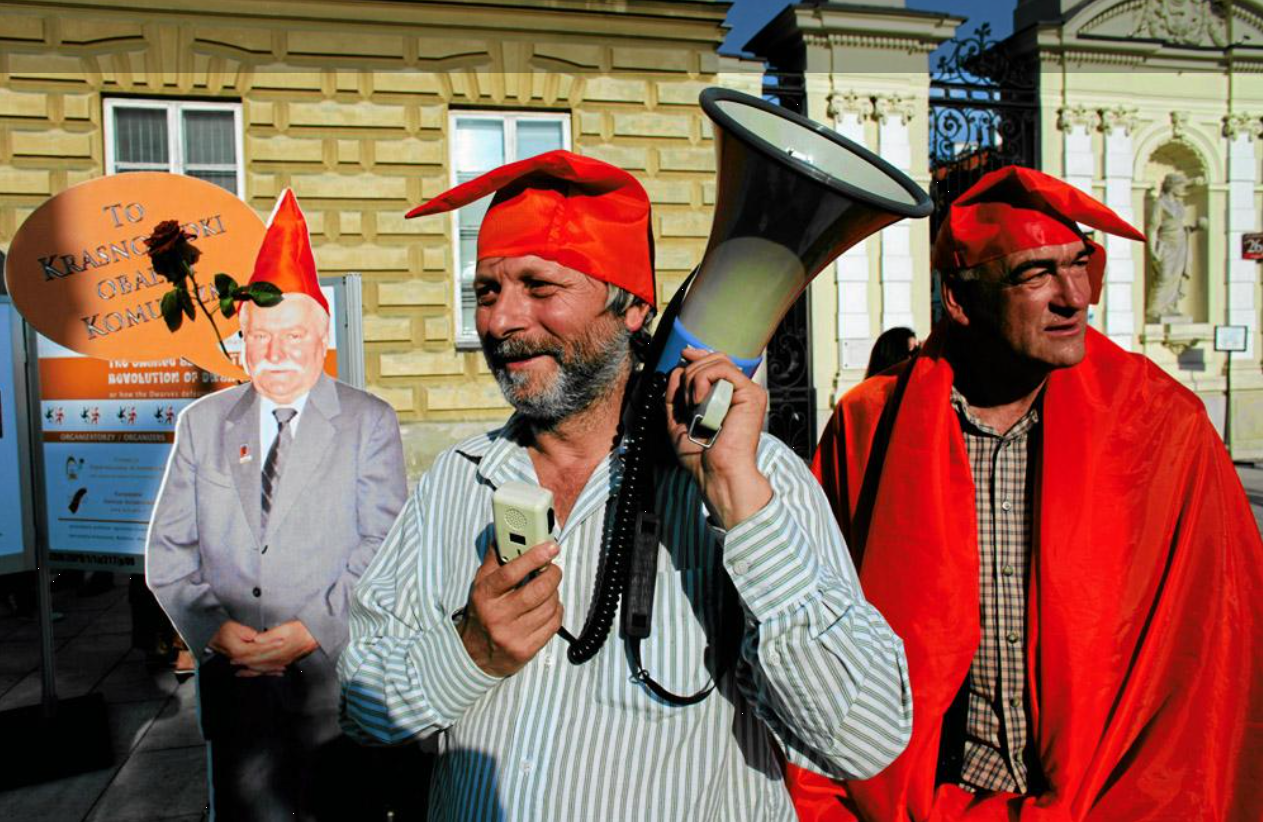
Photo: Robert Kowalewski/AG. Source: culture.pl
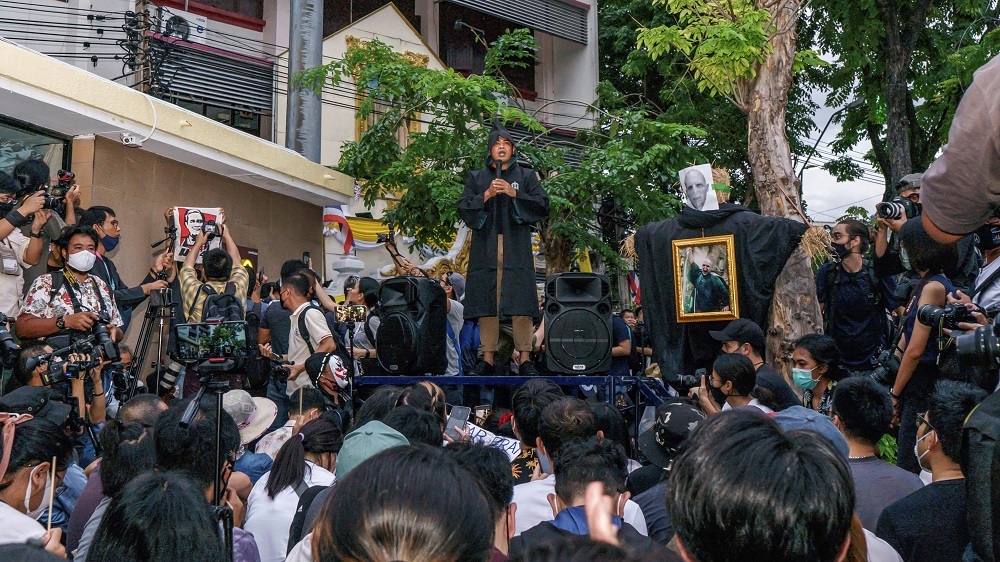
Inspired by Marsh and Śliwa, this research paper offers a comparative analysis which illustrates how Poland’s Orange Alternative’s parody of Smurf-like police officers and the movement’s symbolic revolution of orange dwarfs and gnomes (Figure 1)3 can be “translated” into elements of Thailand’s youth-led movement: its parody of the “dinosaur-and-million-year-old-turtle” (ไดโนเสาร์เต่าล้านปี) boomers, or right-wing ultra-royalist individuals harbouring obsolete worldviews on gender and nationalism; its giant yellow rubber ducks used as “comic-relief” shields against the deadly chemical-laced water cannons; and its Harry Potter-themed rallies and cosplay against the Dark Lord who should not be named and defamed in a country widely regarded as having the strictest lèse-majesté law in the world (see Frater; Figure 2).4
Figure 2. Harry Potter-themed rally and cosplay in Thailand. Sipa USA via AP
Source : Variety
In the case of Thailand, what drove protesters, especially the young, to the streets was not only a sense of hopelessness aggravated by the Thai government’s mismanagement of the COVID-19 pandemic, but also a desperate g(r)asp of hope for real change:
COVID-19 creates at least two structural opportunities for pro-democracy groups. First, although the Thai public health sector’s response to the pandemic has been effective, leading to a relatively low number of COVID-19 cases (around 25,000 infections and 82 deaths as of 18 February 2021, out of a populace of 69 million), the regime has poorly managed the economic repercussions of two related lockdowns (March–April 2020 and January–February 2021). As millions lost their jobs, the government aid provided to them would be seen as too little, too late – especially compared to its enthusiasm to save big businesses. In light of Thailand’s existing economic disparity, this different treatment of the “haves” and “have-nots” reinforces the perception of elite privilege. For youngsters especially, economic inequality conducive to a lack of opportunities makes it seem that they do not have a bright future in Thailand. (Sombatpoonsiri 3)
In the case of Poland, according to Bronisław Misztal, what drew protesters, especially young people, to the streets were events known as happenings that were invitations for free and open participation, unlike the stringent membership demanded by political parties, underground resistance groups, or other formal organisations:
The ‘Alternative’ does not claim to represent any particular and important segment of society; therefore, no one feels compelled to accept or reject its program. Instead, the movement offers free participation (not a membership) based on an individual’s extemporaneous acceptance of an episode; the Orange Alternative’s structure is based on an individual’s inclinations to join the event. (Misztal 74)
This paper also highlights what Gernot Böhme terms the “aesthetic labour” of young artists in Thailand. For example, the anonymous cartoonist and caricature artist who created the satirical webcomic called “Khai Maew” and the graphic designer behind the “Uninspired by Current Events” graphic art Facebook page, Saratta Chuengsatiansup, both aimed to challenge (linguistic) ideologies of fear by transforming the atmosphere of paranoia permeating Thai society into a mood of play and absurdity through political satire. As stated in the “Manifesto of Socialist Surrealism” (Manifest surrealizmu socjalistycznego) by Waldemar Fydrych (who called himself “Major,” a playful linguistic subversion which satirises military ranks and authority): “Even a single militiaman on the street is an object of art. Let’s play, our fate is not tragic” (qtd. in Misztal 61). Lessons on laughter (which is no laughing matter!) from Poland and Thailand show how protesters can create pop-up “events” or “happening” platforms of joy (Pol. radość),5 which can be regarded as attempts to “move away from dualistic conceptualization of ‘hidden’ and ‘public’ forms of resistance” (Marsh and Śliwa 478).
Penchan Phoborisut’s study of public performances that have employed humour and satire as forms of civil disobedience in Thailand since 2010 is relevant to the Orange Alternative’s case. Phoborisut argues that anti-government events/happenings constitute what Deleuze and Guattari describe as assemblages, or new modes of functioning produced through invented configurations of heterogeneous entities. Motivated by the desire to emerge and protest, these disparate entities create unexpected connections that give rise to new realities and expressions. Assemblages enable a reimagining of what protest looks like under conditions of strict control, as well as how objects and people exert force in acts of contestation. They serve as mediating points through which fragmented elements come together, connect, and operate in inventive ways (476). This paper is inspired by Phoborisut’s analysis and the work of Deleuze and Guattari, as, in both Poland and Thailand, protesters needed to simultaneously negotiate with and rebel against the limitations of their linguistic ideologies or worldviews, resulting in creative and innovative cultural dissent which resists even the pigeonholing of historical grand narratives (Lyotard) to the extent of its exclusion from mainstream narratives of resistance. The Thai youth-led protests and the Orange Alternative are epistemically marginalised: the former tend to be portrayed as an inevitable failure when measured against conventional notions of resistance movements and Thailand’s realpolitik,6 and the Orange Alternative is not even mentioned in history books like 1989: The Final Curtain (Głogowski), published by the KARTA Center Foundation (Ośrodek KARTA) and co-financed by the Ministry of Foreign Affairs of the Republic of Poland – as the concluding section of this paper will explain.
Methodology and Theoretical Concepts: CDA and Epistemic Violence
To examine how society is embedded in, and can be traced through, text and language, this paper employs critical discourse analysis (CDA) as its methodological framework. The events/happenings of political protest in Poland and Thailand aimed to negotiate with, as well as resist, discursive domination by elite groups or institutions that perpetuated violence and propagated the language of fear. Such discourse domination and manipulation, according to Van Dijk, control not only the people’s minds but also their actions.
The kind of violence inflicted through the language of fear may be understood as epistemic violence, defined as “forms of knowledge production that deny or undermine the agency and subjectivity of particular populations” (Lokaneeta 1010). The connection between power and the construction of knowledge about the other has placed epistemic violence at the centre of postcolonial scholarship, debates, and discussions. According to Gayatri Chakravorty Spivak, “meaning/knowledge intersects power” as “the project of Imperialism is violently to put together the episteme that will ‘mean’ (for others) and ‘know’ (for the self) the colonial subject as history’s nearly-selved other” (255). Ola Abdalkafor traces the postcolonial critique of epistemic violence to Spivak’s analysis of imperialism, arguing that this form and structure of violence sustain what Spivak terms “worlding”: the process by which imperialism produces “the division of worlds which were not present before colonisation” (11). Furthermore, Abdalkafor notes that “the West started to create and sustain certain images of the colonised peoples. These images gave European societies the stereotypes of the uncivilised Other and led them to justify and support the civilising mission which was the pretext of colonization” (11).
Moira Pérez writes that epistemic violence refers to “the different ways in which violence is exercised in relation to the production, circulation and recognition of knowledge: the denial of epistemic agency for certain subjects, the unacknowledged exploitation of their epistemic resources, their objectification, among many others” (1). As a structural phenomenon, epistemic violence may be propelled by individual actions while remaining independent from them. It therefore differs from conventional definitions of violence, which typically involve identifiable agents (individual or collective, e.g. institutional violence), specific actions, and clearly confirmed victims. Instead, epistemic violence is gradual, cumulative, and diffuse because it tends to lack precise location, temporality, and identifiable perpetrators. Since it often remains imperceptible even to its own victims, its effects extend far beyond the censorship of individual voices, calling into question the binary opposition of victim vs. victimiser. Miranda Fricker argues that epistemic violence results in the denial of epistemic authority, in which subjects are undermined and labelled as unreliable sources of knowledge. This is the reason why epistemic violence can, as Rob Nixon points out, be regarded as “slow violence,” or “a violence that occurs gradually and out of sight, a violence of delayed destruction that is dispersed across time and space, an attritional violence that is typically not viewed as violence at all” (2). Such violence tends to go undetected by those who do not critically reflect on their own and others’ epistemic practices, leading to a complete lack of awareness and attention in the public agenda. The maximum degree of epistemic violence is what José Medina calls “epistemic death” or “hermeneutical death,” which means the annihilation of the self “when subjects are not simply mistreated as intelligible communicators, but prevented from developing and exercising a voice, that is, prevented from participating in meaning-making and meaning-sharing practices” (41).
As the following case studies demonstrate, when fear-infused epistemic violence serves necropolitical purposes, one witnesses the silencing and dehumanisation of a certain individual or groups of people through culture and language. Consequently, the terrain of resistance shifts from the domains of law and legislation to those of art and culture, with humour functioning as both fortress and artillery. Laughter is far from a mere laughing matter. Culture is a powerful agent of political change.
Expelliarmus!: Disempowering Polish Smurfs, Thai Dinosaurs, and He Who Should Not Be Named
Triggered by the dissolution of the Future Forward Party by the Constitutional Court on 21 February 2020, youth-led protests in Thailand began with demonstrations against the government of then Prime Minister Prayut Chan-o-cha, a retired army general who rose to power after the coup he led in 2014. Since the dissolved Future Forward Party had gained tremendous popularity and significant support among Thai youths for its uncompromising demands for change and criticism of the administration, embedded in their demands for military reform and for the reform of Section 112 of the Thai Criminal Code (lèse-majesté law), its dissolution crushed the younger generation’s hopes and dreams. The Constitutional Court ruling was perceived as yet another instance of military intervention in Thai politics. Street protests in Bangkok and many other provinces in Thailand, as a result, were increasingly loud in their unprecedented demands for reform of the Thai monarchy, particularly demands to repeal Section 112, often misused to police and incarcerate dissidents. Pop culture was appropriated in the fight against the ultra-royalist and pro-militarist ideology of the state, as, similar to the iconic dwarfs or gnomes in Poland’s Orange Alternative, Thai activists who wished to abolish the lèse-majesté law projected themselves as powerless “little people.” Like Harry Potter, they courageously stood up and fought against their own version of Lord Voldemort, known as “He Who Must Not Be Named,” “the Dark Lord,” or the Royal “You-Know-Who” – references to those in power who exploited the lèse-majesté law to persecute critics. Humour, as a way of coping with dissonance or escaping hopeless situations, was honed through satire and parody; students organised flash mobs, and carnivalesque events/happenings were staged at many protest sites across Thailand (2020–2021).
By positioning themselves as “little people,” albeit commoners with uncommon (almost magical) ambition to tackle necropower, the Harry Potter mob used language that was embedded in the context of the anglophone literary and cultural world, and this resonates with the Orange Alternative’s use of krasnoludki, meaning “dwarfs and gnomes” – although the etymological root implies a subtle political position. Krasnoludki is a compound of krasny, which means “red,” “colourful,” or “nice-looking,” and the diminutive ludki, which means “little people.” The emphasis on self-effacing size and scale7 reflects the fact that the Orange Alternative offered an alternative to the people who felt “belittled” by both the stifling Communist regime and the rigidly religious and predictable mainstream resistance movement, namely, Solidarity (Solidarność):
While the communist authorities somehow came to grips, [sic] with the unwanted existence of Solidarity, they apparently feared the unspecified number of young happeners who were capable of swinging the emotions of the urban folks. The key obviously lies in the fact that however oppositional Solidarity was, it was, nevertheless, predictable. But the movement which is fluctuant, does not have clear structures and, most of all, cannot be attributed to any anti-state political program is much more of a problem. (Misztal 62)
Young people in Thailand found themselves at a similar crossroads. They did not wish to align themselves with the military regime or its right-wing conservative supporters. At the same time, they did not identify with the visible mainstream opposition, the Pheu Thai Party, symbolically and spiritually led by the former Prime Minister Thaksin Shinawatra (ทักษิณ ชินวัตร), who was ousted by a military coup in 2006.8 The younger generation tended to perceive this party and its shamelessly compromising stance as “not radical enough.” The movements in both Poland and Thailand transcended a horizontal binary opposition by offering the public an alternative between two predictable poles of power. When laughter is used as resistance, humour vacillates between the vertical binary opposition of “public” and “hidden” forms of resistance, signifying a move away from it. Given that both movements lacked fixed, formal structures of leadership and management, they were, like laughter itself, unpredictable and dangerously evasive.
When Polish citizens “cosplaying” (to use the transnational and contemporary term) as dwarfs and gnomes wearing comical orange cone-shaped hats were arrested by serious police officers clad in blue uniforms, the sight was so absurd that the police were included in the protest’s theatricality. By referring to the police as “Smurfs,” the protesters undermined, or “reduced in scale,” the authority of the men in uniform. The Orange Alternative’s in-your-face parody of Smurfs, dwarfs, and gnomes can be translated into Thailand’s youth-led pro-democracy movement. The latter used the image of dinosaurs to represent right-wing ultra-royalist conservative “boomers” with obsolete views on education, gender, and sexuality. Giant yellow rubber ducks became their icon and served as comic-relief shields against the deadly chemical-laced water cannons:
It was clear that various types of violence—from tear gas to high-pressure chemical water cannon—used by the state could undermine morale. Consequently, the movement had to adopt new tactics. Symbols became a handy tool, replacing laughter with something more serious and more representative of the struggle of the masses. The use of the Hunger Games’ three-finger salute was the first symbol used to represent the movement’s three demands. The rubber duck was introduced later as a mascot of the movement and a mockery of the state—a mere plastic toy turned into a security threat. (Skulchokchai 332)
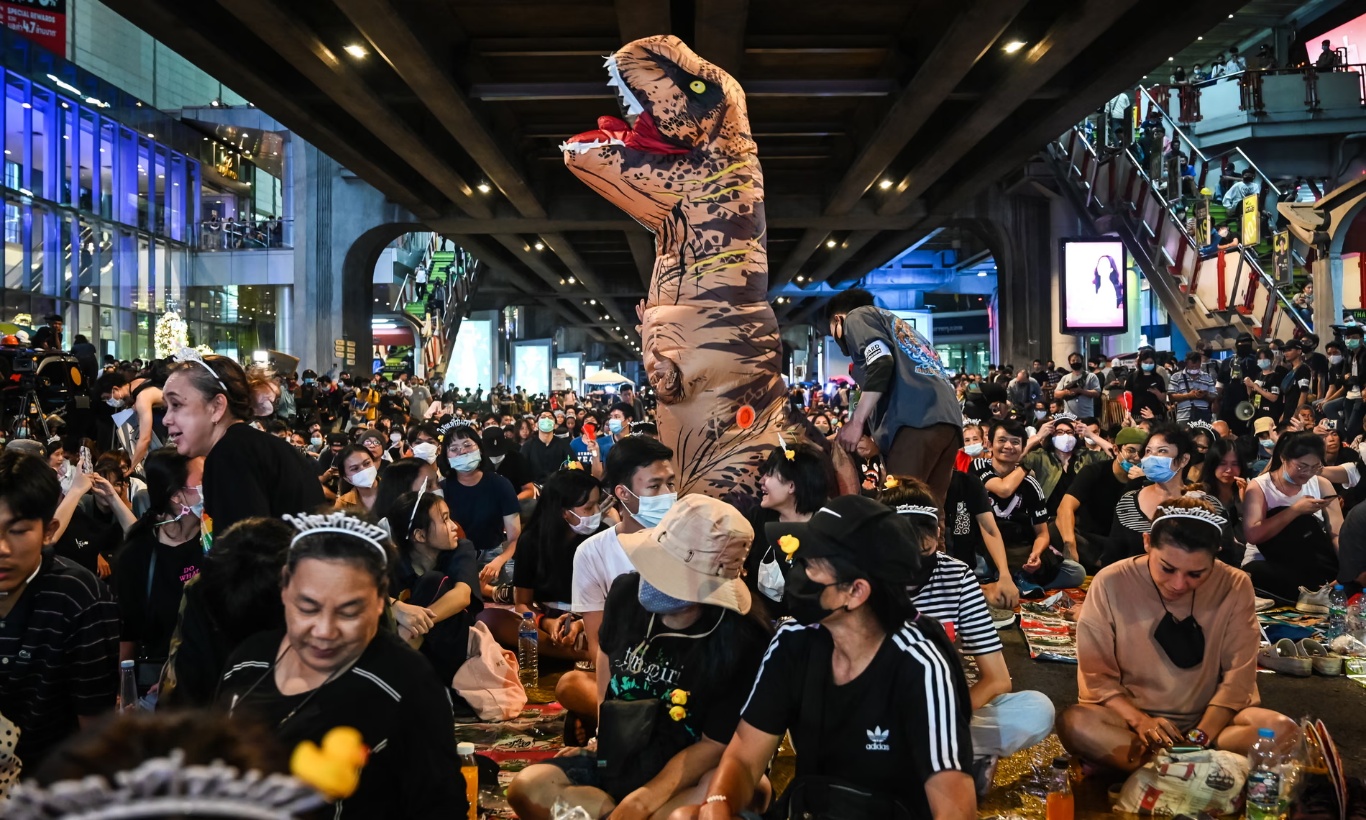
The dinosaur events/happenings/flashmobs in Thailand were led by groups of school students who were fed up with what they comically and contemptuously perceived as “dinosaur-and-million-year-old-turtle” (ไดโนเสาร์เต่าล้านปี) boomers who had miraculously survived meteors. They opposed “dinosaur-aged” authoritarianism in schools, where senseless rules were imposed in the name of moral righteousness – so much so that these students preferred to call themselves the “Bad Students Group.”9 Thailand had reached the point where good meant bad and bad meant good: “at one point that state of hegemony in Thailand was similar to that of the late socialist Soviet Bloc, as every act was reduced to face value and people performed meaningless acts in order to fit in” (Skulchokchai 333). Poland has also seen its fair share of meaning inversions and euphemisms. In particular, the Nobel Laureate Olga Tokarczuk described “speech grass” (mowa trawa) as meaningless, or “language that’s simply there, that communicates nothing in particular, that can only be a ritual, a shouted slogan. Ideas without contours, suitable only for chants” as a part and a result of propaganda.
Figure 3. Students, including one in a dinosaur costume, gather for a pro-democracy protest in central Bangkok. Photograph: Sirachai Arunrugstichai/Getty Images
Source: The Guardian (Ratcliffe and Siradapuvadol)
The Thai equivalent of the Polish Smurf was the yellow Minion from Illumination’s Despicable Me franchise. The Minion flashmob dance at a demonstration in Bangkok on 29 October 2020 was a scathing attack on the ultra-nationalist, royalist “yellow shirt” groups, which supported the coup and the military regime. The English word and its meaning, as well as the metaphor of “minion,” were used to satirise their servility and blind obedience to authority.
Figure 4. Thai pro-democracy protesters dress up as Minions to mock Thai royalists in Bangkok, Thailand. October 29, 2020. Lauren DeCicca
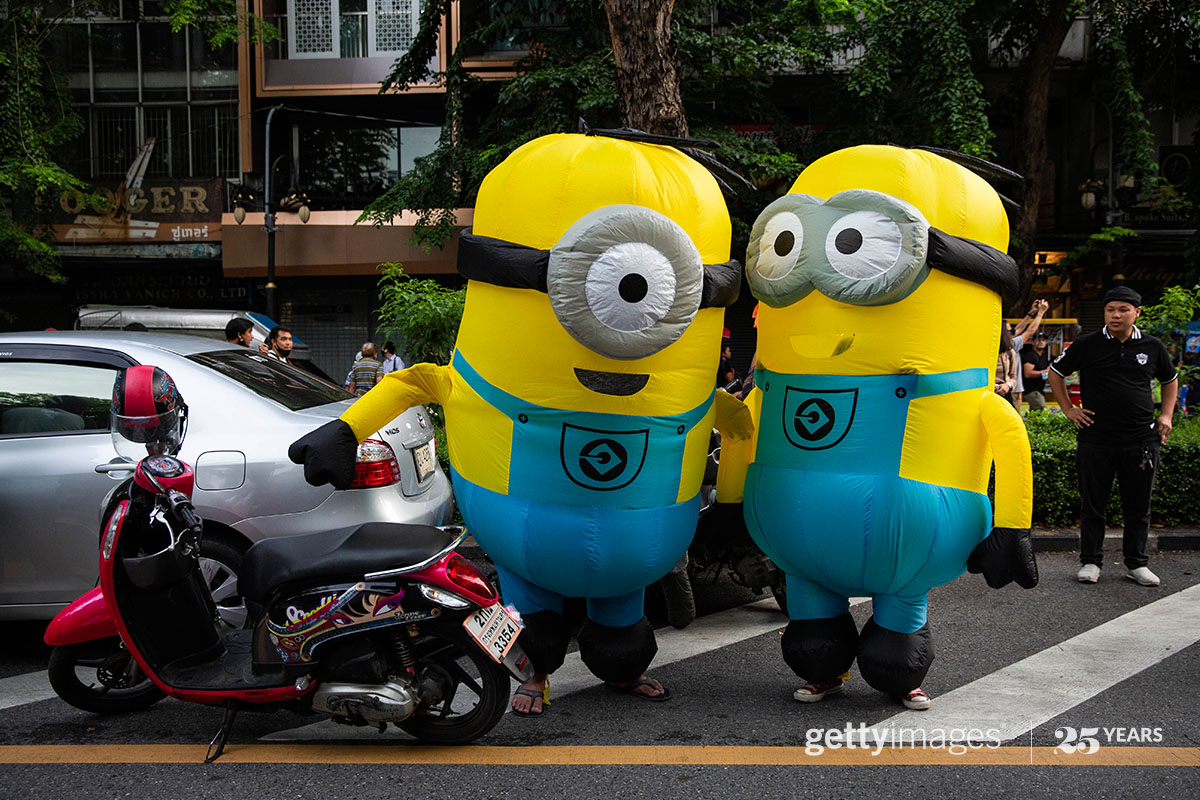
Source: Getty Images (“Thai Pro-democracy Protesters”)
Cracking the Coconut Shell: Empowering Orange Dwarfs/Gnomes and “Starry-Eyed” Commoners
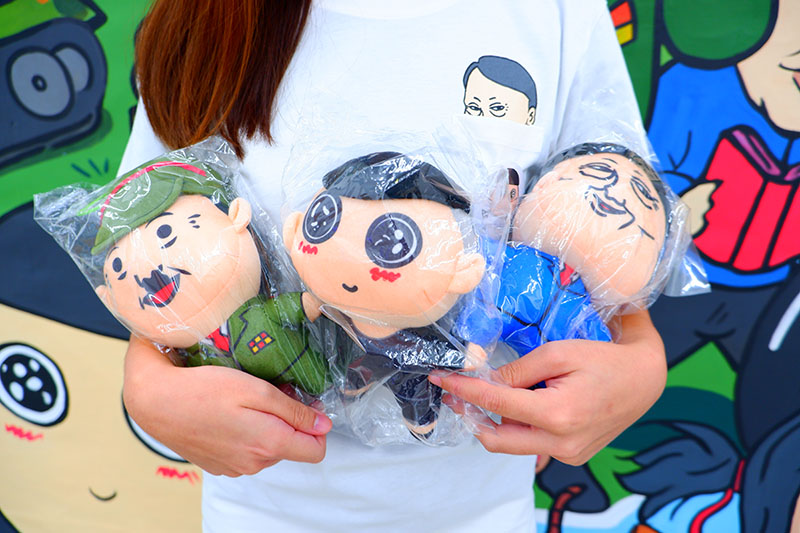
In the middle of the photograph in Figure 5, taken at the “Khai Maew X: Kalaland” (Khai Maew X: Land of the Coconut Shell) exhibition in 2018, one can observe a soft toy that stands for an “everyday commoner/citizen.” The character is named Ta Sai (ตาใส), literally “pure/transparent eyes,”10 created by an anonymous caricaturist behind the Khai Maew (ไข่แมว) webcomic.
Figure 5. Ta Sai (ตาใส), “Khai Maew X: Kalaland” (Khai Maew X: Land of the Coconut Shell) exhibition, 2018
Source: Khaosod English
Ta Sai, or “starry-eyed,” is depicted as a boy in black with a mop top or bowl cut, which in Thai is called a “coconut shell” haircut (ผมทรงกะลาครอบ). This is a play on the Thai idiom “frog in a coconut shell” (กบในกะลา), equivalent to the English idiom “living under a rock,” which is used for saying that someone has a sheltered existence, oblivious to what is happening around them. This signifies how “starry-eyed” commoners are ruled under the coconut shell firmly forced on them by the authoritarian regime. Most importantly, “starry-eyed” represents the disempowered “little people” in Thai society who have been oppressed, exploited, and subjected to ignorance by a power that could not be named or defamed in the coconut-shell land ruled by the inviolable and unassailable lèse-majesté law. In the past, the “coconut-shell” haircut was compulsory for students in many government-run schools in Thailand to the extent that it has become a symbol of docility in the face of senseless rules and regulations.
In the same photograph, the way in which “starry-eyed” is placed between two characters is highly significant. On the left, the General represents not only Prayut Chan-o-cha but also the militarist culture and values responsible for repeated coups d’état; on the right, Thaksin represents the symbolic leader of the mainstream opposition at the time. This can be interpreted as a symbol of how starry-eyed commoners/citizens of Thailand, hoping for more radical reforms, were torn between the Junta regime and the kind of opposition that was tolerated by the military establishment.
Both the Orange Alternative and the Thai protest movement used laughter, which is often dismissed as “decaf” or ineffective resistance compared with overt confrontation. Affective resistance leads to Hynes’s “affective transition.” Laughter, like the pandemic, is dynamic, transitional, and contagious, inviting everyone to help dismantle the necropower of authoritarian regimes. Laughter can be seen as the parasitical nature of subversive power as it ruthlessly excorporates11 the language and discourses of power established by the authority and, by doing so, dismantles it:
To maintain organizational political arrangements, affective dynamics are crucial, both to mobilize members and to enforce compliance with rules. At base, such processes are comparable when it comes to the state itself governing its citizens or to a group of dissidents resisting the state. The wielding of power, either in order to govern or to resist, is fundamentally an affective process. (Slaby and Bens 345)
The artistic endeavours of both the Orange Alternative and Thailand’s youth-led pro-democracy movement can be regarded as examples of Böhme’s “aesthetic labour,” which “embraces all human activities that lend to things, people, and ensembles that go beyond their handiness and objective presence, their materiality and practicality” (77). It is the kind of labour that transforms society’s atmosphere of fear and paranoia into a mood of play and absurdity through political satire.
From “Away with Police Truncheons” to “All Ears”
The Orange Alternative’s iconic happening took place in July 1987. Each member wore a letter of the alphabet, which collectively formed the phrase Precz z upałami (“Away with the Heat”). When the police walked past, the group sent out a harmless message. However, when the person wearing the U-letter t-shirt turned around or walked away, the message was suddenly transformed into a clear attack on police violence: Precz z pałami (“Away with police truncheons”). The choreographed wordplay’s ambiguity and swift spontaneity can be seen as a perfect example of the strength and unique creativity of the Orange Alternative (Figure 6).
Figure 6. Piotr Lewiński, Wikipedia (CC BY-SA 2.5)
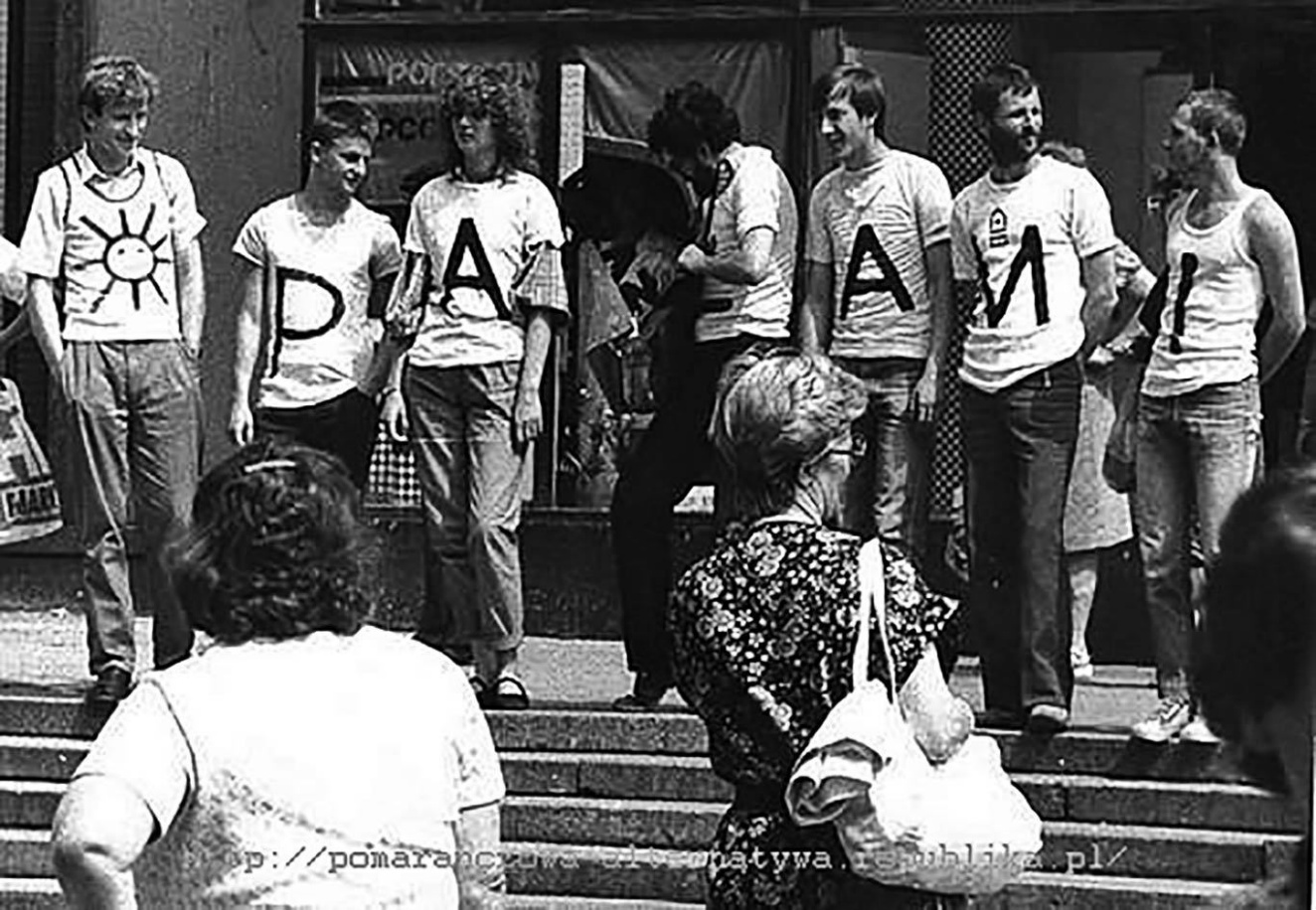
Source: sztukapubliczna.pl/. (“Pomarańczowa Alternatywa”)
The triviality of such a semantic pivot and its (inter)play of obedience/disobedience provided the public with a “breath of fresh air” equally from the heated Communist censorship and from the formulaic opposition laid out by the Solidarity movement:
The Orange Alternative is not a fixed social organization, nor is it a regular movement which, like Solidarity, would have a negative program (i.e., an agenda of issues to which the movement is opposed). Instead, the ‘Alternative’ is completely unpredictable, floating and flexible. It responds to the pettiness of official and oppositional forces, mocks the grandiose and meaningless decorativeness of Polish life, and tries to help people to get rid of ambivalence and ambiguity. (Misztal 64)
A similar performative pun appears in Saratta Chuengsatiansup’s graphic art, which was intentionally titled in English rather than Thai: “All Ears” (Figure 7).12 This wryly and wittily echoed the empty claim made by the Thai government that they were “All Ears,” or attentive to the will and voices of the people, while, in reality, not listening at all. Heeding only the voices of those in power, the Dalí-like gigantic ears seemed to outgrow the heads, brains, common sense, and humanity of the crowd that law enforcement officers tried to suppress, coerce, and silence for criticising the government. This graphic art harks back to the violent suppression of a demonstration in November 2022, when police fired rubber bullets at people who were protesting peacefully during the APEC summit in Bangkok.
Figure 7. “All Ears” by Saratta Chuengsatiansup
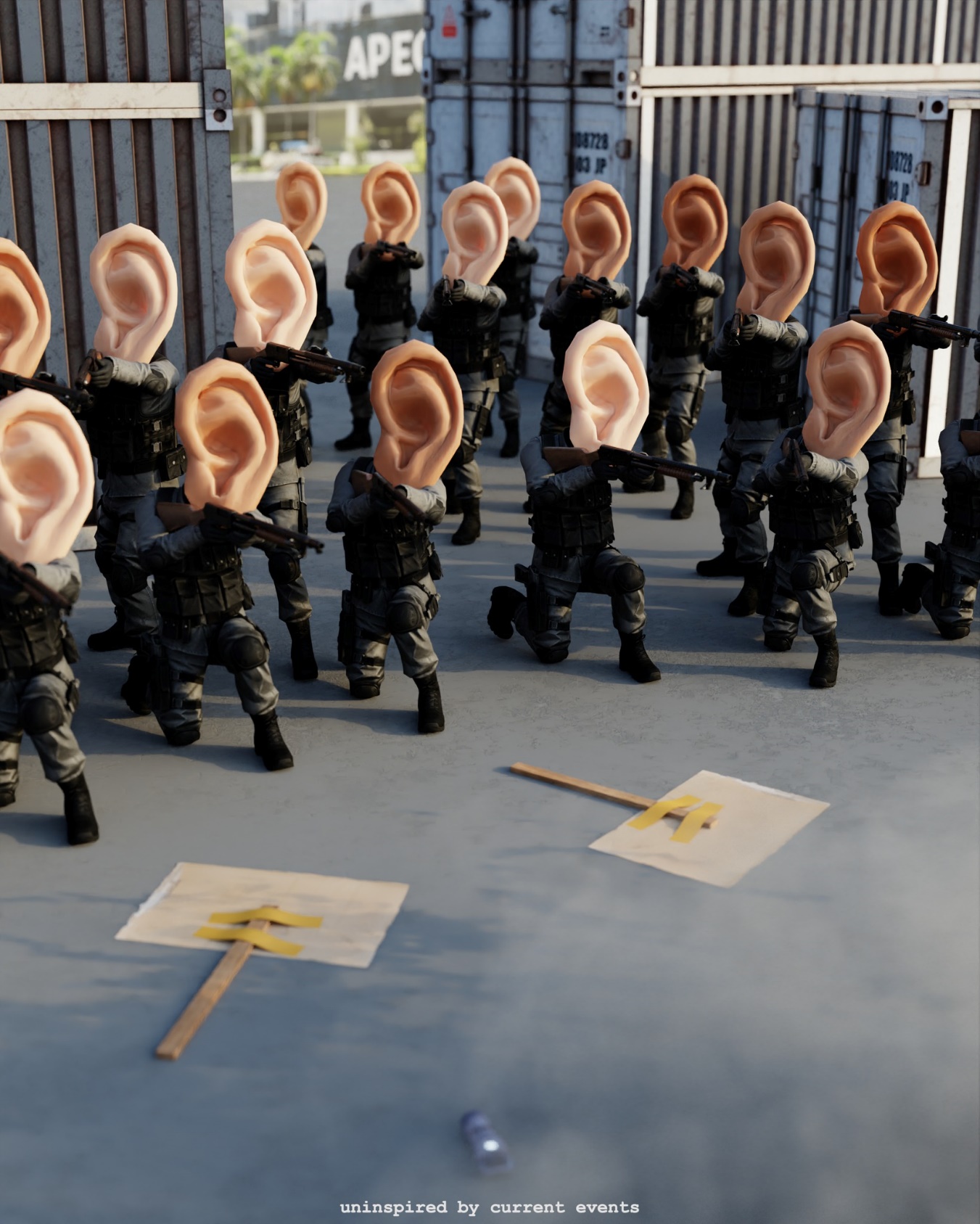
Source: Uninspired by Current Events Facebook page (18 November 2022)
The Thai and Polish dissident movements examined in this paper mobilised art, language, and culture as critical instruments for exposing necropolitical regimes. As Achille Mbembe theorises, necropolitics may be understood as an exercise of power that determines not only who may live and who must die, but also who is consigned to conditions of slow death, social dispossession, and abandonment. Necropolitics operates both through and on forms of physical and epistemic violence, the latter functioning through the gradual and often imperceptible erosion of an individual’s capacity to interpret, articulate, and sustain their own social reality. Epistemic violence manifests in the systematic contamination, diminution, and, at times, erasure of one’s social and economic standing, alongside the erosion of one’s fundamental rights and dignity as a human being. The pervasive effect of fear sustains it. In response, protest movements in both Poland and Thailand have sought to reconfigure the discourse of fear by disrupting and reclaiming the physical and semiotic spaces through which epistemic violence is enacted. In doing so, they revealed that fear is not the only potentially contagious emotion: laughter, too, circulates – perhaps even more virally – as an unruly and irrepressible force that resists containment.
Conclusion
As mentioned earlier, the 1989: The Final Curtain (KARTA Center Foundation) history book is an example of epistemic marginalisation and omission, erasing the Orange Alternative from the grand narrative of resistance history. Epistemic violence does not end when a regime falls.13 Erasure persists in the production of official histories that privilege “serious” political actors, namely, parties, negotiations, elections, etc., over the aesthetic labour and carnivalesque disruptions which animate social hope:
The Orange Alternative contended that reifying rationalism of the 1970s was a dead end for individual development and that philosophers or intellectuals played a servilistic role in this process of capturing of human minds. The fact that individual freedom survived can be attributed to clumsy politicians whose activity created surrealism, which, in turn, freed individual minds. It is significant that at the time when workers, peasants, students–practically everybody–turned to some form of conspicuous religious behavior, the ‘Alternative’ proposed freeing one’s mind from this type of dependency. (Misztal 61)
As mentioned earlier, the Thai case is equally vulnerable to such downplaying: youth-led protests are often dismissed as failures when measured against realpolitik or narrowly defined institutional outcomes. Such narratives misrecognise the insurgent creativity through which new forms of collective agency emerge. What the comparative study of Poland and Thailand ultimately reveals is not merely that humour can puncture the affective atmosphere of fear, but that laughter itself becomes a site of epistemic world-making. Both the Orange Alternative and Thailand’s youth-led movement demonstrated that resistance is not exhausted by institutional struggle, legal reform, or the choreography of mass demonstrations. Rather, resistance is sustained in the fragile yet potent spaces where meaning is made: in the semiotic, affective, and cultural terrains where necropower attempts to silence, belittle, or erase.
The anglophone context is of paramount importance for all political/cultural happenings that seek not only to mobilise domestic participation but also to claim visibility and legitimacy on the international stage. James W. Underhill’s assertion that each language grants access to a particular way of seeing and inhabiting the world, and that, in speaking it with others, we in some sense dwell within that world, is sharpened by the fact that English is the language that many also use to “make their homes in the world”:
All citizens are actors, whether they play passive or active roles in adopting, imposing or resisting dominant political discourse. In the same respect, though each language opens up to us a ‘world’, and though we do, in a certain sense, ‘make our homes in the world’ when we speak our language with others, each language system opens up a sphere for creative conceptual thought. Freedom and expression are inextricable. Individuals choose either to accept or to resist and to modify the concepts that their mother tongue and cultural mindset provide them with. (Underhill 6)
Underhill’s views are evident in the Black Protests, a mass feminist and pro-democracy mobilisation against attempts from the Polish government, led by the right-wing Law and Justice Party (PiS), to introduce a near-total ban on abortion, which erupted throughout Poland in 2016:
Black Protests were indeed joined by women from all walks of life, and swept across urban centers and small towns. In addition to the attention that these newly established collectives pay to barriers of class and geography, what is striking about many of them is their post-ideological character. These groups aim to attract wider audiences and build broad-based movements, and as such choose to be guided by values such as solidarity or human rights rather than political unity. Often this is couched in a liberal lexicon where issues of economic justice are sidelined. (Hall 1508)
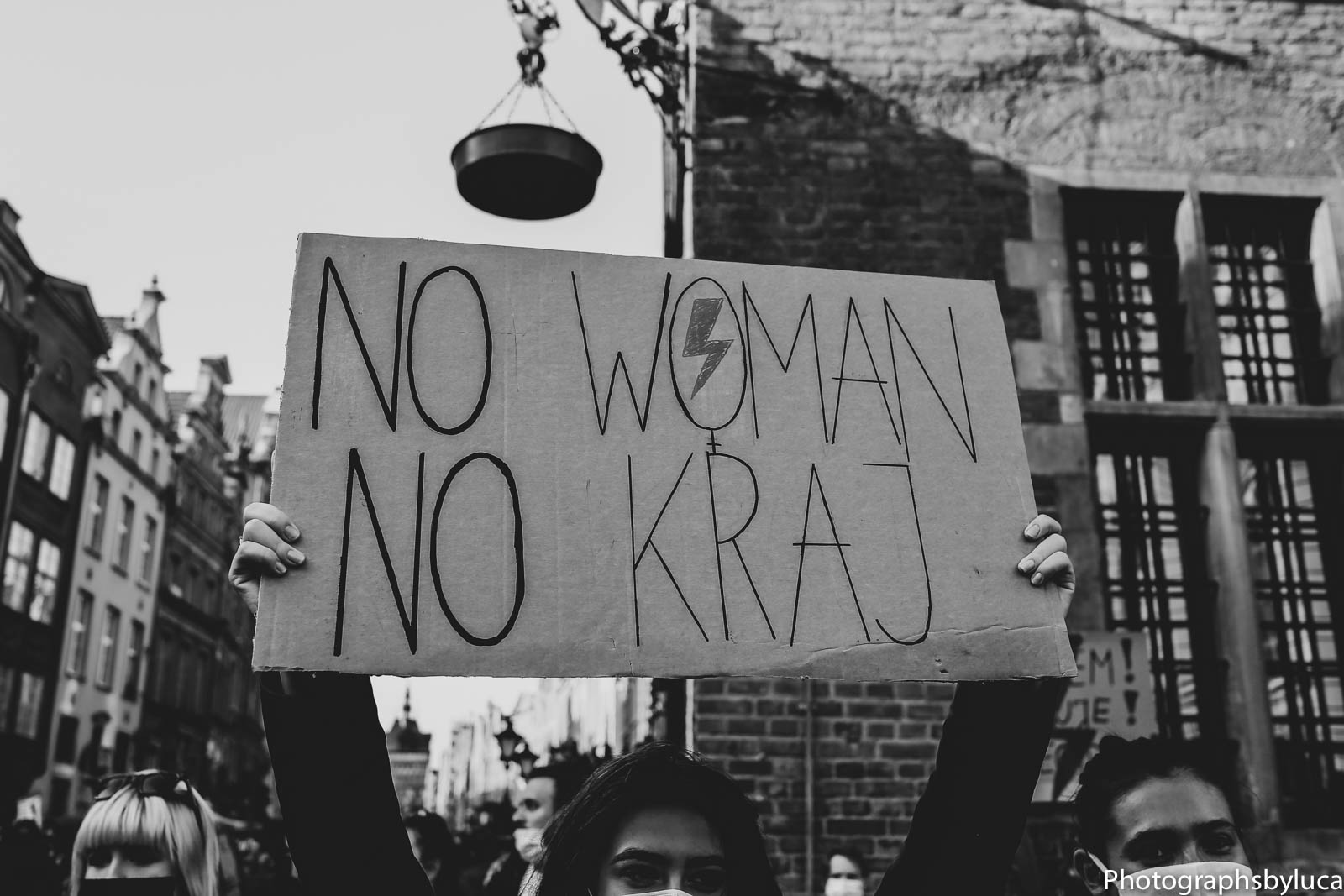
One of the slogans associated with the Black Protest is No Woman, No Kraj (Figure 8), an allusion to and deliberate play on Bob Marley’s famous reggae song No Woman, No Cry: kraj (pronounced like the English word cry) means “country” in Polish. The wording was crafted with an anglophone audience in mind. By translating local grievances into globally recognisable idioms, activists ensured that their struggle resonated beyond national borders, garnering international solidarity and placing additional pressure on the state.
Figure 8. No Woman, No Kraj banner in the Polish Black Protests
Source: Notes from Poland (“Poland’s Abortion Protests”)
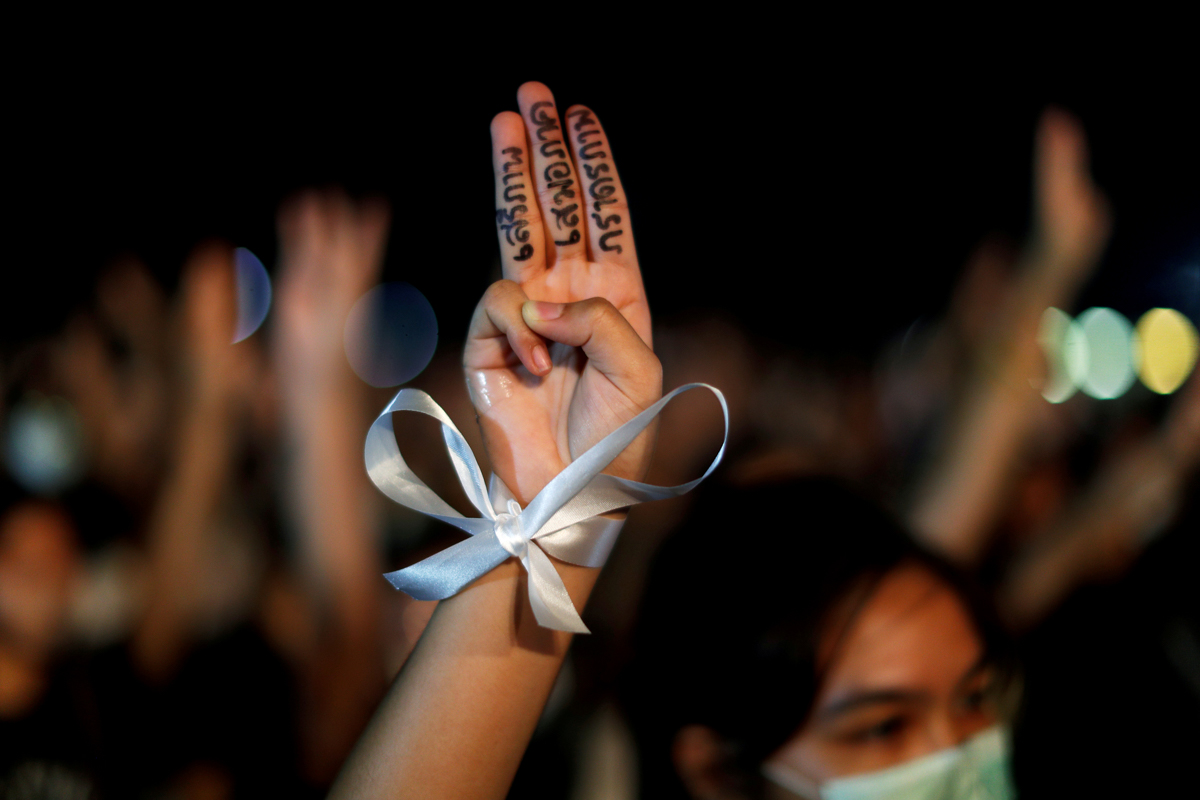
In Thailand, the emergence of the three-finger salute as a central symbol of youth-led protests demonstrates how indispensable the anglophone cultural sphere is for generating political meaning that resonates both domestically and internationally. An allusion to The Hunger Games, the gesture carried with it a ready-made vocabulary of rebellion, solidarity, and defiance against authoritarian rule. This intertextual borrowing allowed protesters to frame their struggle through a globally recognisable narrative of oppressed citizens rising against state violence. The anglophone origin of the symbol amplified its communicability. International media could immediately interpret the reference, while Thai protesters used it to articulate a shared political imagination grounded in transnational pop culture. Thus, the three-finger salute (Figure 9) illustrates how anglophone cultural products provide Thai activists with semiotic resources that generate affective power at home and legitimacy abroad.
Figure 9. A pro-democracy student raises a three-fingered salute, with “Freedom, equality, and brotherhood” written on their hand and a white ribbon around their wrist. [Jorge Silva/Reuters]
Source: Al Jazeera (“In Pictures”)
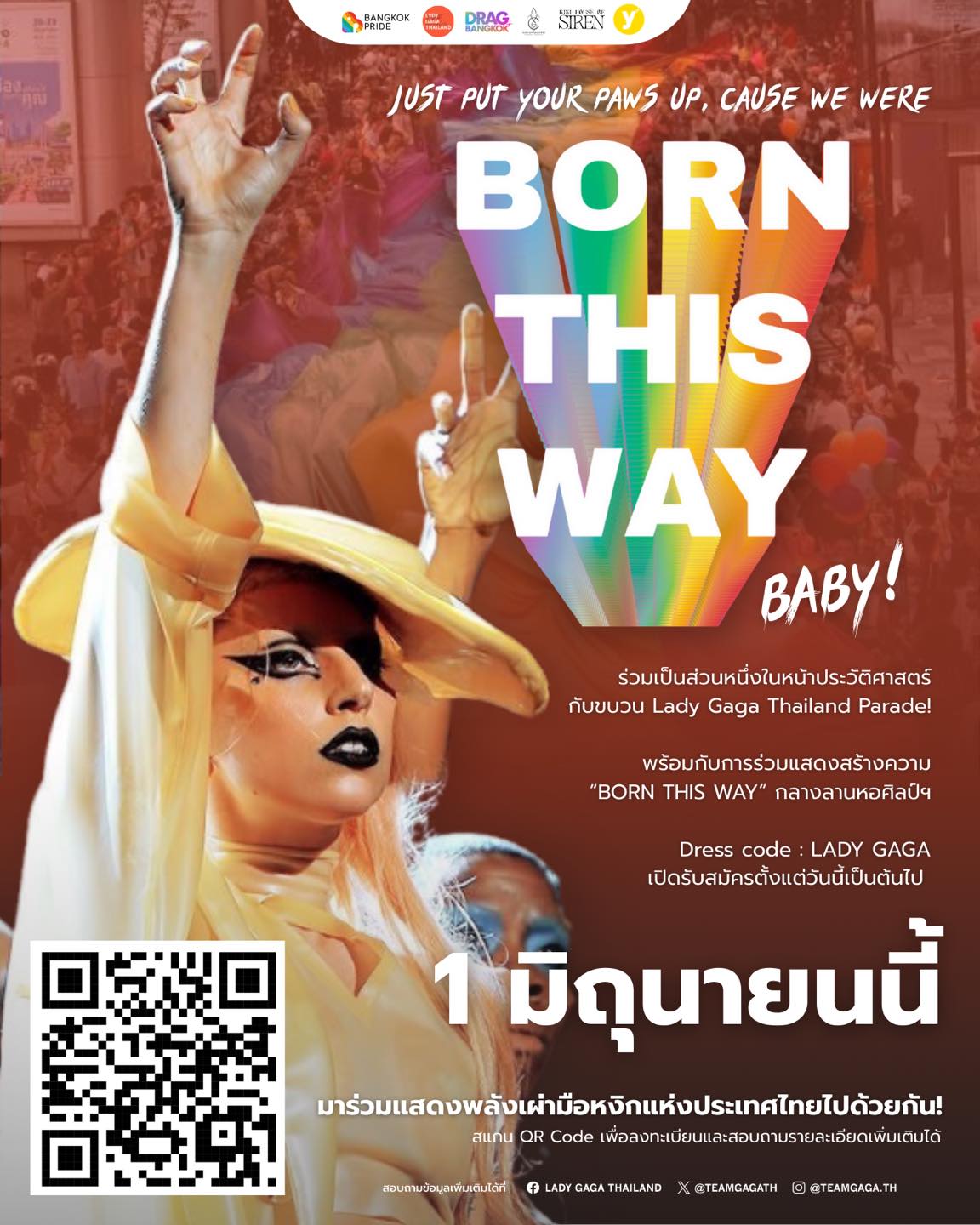
The Orange Alternative and the Thai youth-led dissident movement’s refusal to use the epistemic scripts assigned to them, as well as their refusal to accept the ontological impoverishment imposed by necropolitics, may inspire other pro-democracy causes, as well as feminist and LGBTQIA+ rights campaigns (Figure 10).
Figure 10. “We’re ready to be BORN THIS WAY together!” Source: Lady Gaga Thailand (“We’re Ready”)14
Through parody, absurdity, cosplay, linguistic subversion, caricature, and the staging of joy (Pol. radość) amidst repression, protesters carve out alternative atmospheres in which tyranny (also in the form of patriarchy and heteronormativity) appears ridiculous rather than omnipotent. Laughter becomes a counter-discourse that disorients sovereign power precisely because it cannot be easily categorised, predicted, or neutralised.
If necropower seeks to determine whose lives matter, humour undermines the very terms through which such determinations are made, demonstrating that even the smallest gesture of mockery can reconfigure the symbolic order. In this sense, laughter is indeed constitutive. It not only excorporates old and present atmospheres, but also creates new atmospheres, new solidarities, and new political possibilities.
Laughter is never and should never be a laughing matter.
Acknowledgement
This research paper is supported by the Grant for Presentation of Research Abroad offered by the Faculty of Arts, Chulalongkorn University, and funded by the Centre of Excellence in Translation, Interpreting, and Intercultural Communication at Chulalongkorn University. An earlier version of this paper was presented under the title “‘Laughter, No Laughing Matter’: Affect as Epistemic Resistance against Necropower in Poland’s Orange Alternative and Thailand’s Youth-led Pro-democracy Movement” at the BASEES (British Association for Slavonic and East European Studies) Annual Conference 2023. The author would like to thank the editors and anonymous reviewers for their constructive comments.