Introduction
The present study centers on the autobiographical novel Pimp: The Story of My Life by Robert Beck, written under the pseudonym Iceberg Slim (1967/1987/ 2011), and its Romanian translation, Viața mea de pește, by Mihnea Gafița (2022). Known for its unfiltered portrayal of urban American life, the work reflects the author’s transformation from a player of the underground world of pimping to a writer whose narrative voice exposes the realities of that milieu. Employing African-American Vernacular English (AAVE) and explicit language, the novel constructs the protagonist’s identity within a hidden and often violent social environment, offering a stark, unembellished depiction of brutality, cunning, and greed. Through the portrayal of this sociocultural context, the author explores themes of survival, exploitation, and racial bias. Gafița, an experienced Romanian translator who regards translation as a cultural act, advocates fidelity to the original text without omission or censorship, while ensuring stylistic naturalness in the target language so that the translation reads as an authentic Romanian text. This chosen perspective hints at the challenges posed by translating a linguistically and culturally marked narrative, highlighting the translator’s role in mediating between distinct linguistic and sociocultural worlds.
Against this background, the role of taboo language is particularly significant. In literature, taboo language serves as more than mere stylistic color; it is a potent tool for shaping identity, signaling ideological stance, and positioning the speaker within specific social hierarchies. In his memoir Pimp: The Story of My Life (henceforth, Pimp), Iceberg Slim’s use of profanity and street slang operates as a defining element of the narrative voice, reinforcing both the authenticity of the autobiographical persona and the sociocultural realities he represents. This study aims to examine how marked language (here, taboo language) functions not only as expressive ornamentation but also as a strategic device for identity construction, ideological positioning, and reader engagement, and how these effects are negotiated in translation.
Drawing on Debray’s (156) work on swearing, identity, and power in professional interaction, taboo language can be understood as relational work: it constructs identities, and it denotes social positions within multilingual or multicultural contexts. This functionalist perspective is highly relevant to Slim’s memoir, in which profanity and informal speech are the main linguistic means of articulating and performing identity and ideology. Unlike neutral language, swearing produces distinctive pragmatic and psychological effects (cognitive, autonomic, interactional, rhetorical, emotional, cathartic, and physiological) that intensify the narrative’s expressive force and sociocultural authenticity. From this observation emerges our central question: In literary translation, how does the rendering of marked language (taboo and slang) shape the construction of cultural identity and mediate the transfer of linguistic ideologies?
The frequent use of raw expletives, including whore, bitch, nigger, shit, and dick, injects visceral affect into the narrator’s voice. For instance, Iceberg Slim’s harsh remark, “Listen square ass bitch, I have never had a whore I couldn’t do without.” (Chapter 19) functions not merely as an insult but also as an ideological marker of toughness, hierarchical power, and a street-hardened persona. From an interdisciplinary standpoint, the communicative force of such language stems from heightened emotional arousal, phonological salience, semantic intensification, and sociolinguistic conditioning through repeated association with taboo contexts (Stapleton et al.). In the literary work under analysis, these linguistic choices construct a marginalized yet resilient identity, simultaneously reflecting Slim’s worldview and immersing the reader in the ideological landscape of street hustling. Translation, therefore, requires not only accurate lexical rendering but also negotiation of ideology and cultural recontextualization.
Slang is central to the performance of Iceberg Slim’s persona: an emotionally impenetrable exterior developed as a survival strategy. His storytelling oscillates between triumphant accounts of manipulation and candid recognition of personal and moral costs. Though his diction is blunt (this worked, that didn’t), his prose remains structurally sophisticated, weaving complex arcs that trace both his precarious origins and his immersion in the sex trade.
The memoir’s aesthetic force lies in this duality: street vernacular coexists with reflective exposition, producing a voice that both performs and interrogates the narrator’s identity. This performance has explicit ideological implications, articulating and reproducing the subculture’s norms: toughness, mistrust, transactional relations, and a masculinized rhetoric of control. The inherent contradictions of these norms are also exposed. Slim’s language constructs and legitimizes social identities represented by such lexis as: pimp, con man, women in his “stable,” and rivals. It also indexes broader power relations: gendered domination, survival-driven self-fashioning, and racialized marginality.
NPS Theory and Social Function
Understanding slang and swearing requires more than viewing them as informal speech; they are rooted in psychological and social processes that shape identity and belonging. In Pimp, such dynamics are central, as Iceberg Slim’s narrative depends on marked language to construct persona and ideology. Jay’s Neuro-Psycho-Social (NPS) Theory integrates neurological, psychological, and sociocultural dimensions of cursing, framing it as intentional, rule-governed behavior rather than impulsive expression. This model, alongside linguistic research on slang, marginality, and identity, provides a comprehensive framework for analyzing Slim’s use of taboo language. Within this perspective, cursing becomes a purposeful communicative act shaped by experience, disposition, and culture, particularly relevant to Slim’s prose. Street slang both authenticates the hustler’s voice and enacts the ideological struggles of marginalized subcultures. As Jay (22) notes, cursing is “purposeful and rule-governed,” a view reflected in Slim’s graphic swearing and stylized vernacular, which perform identity and resistance. For instance, his admission that “I had played the hick coppers cheap and here I was with my balls in the fire” (Chapter 16) reveals emotional arousal tied to humiliation, vulnerability, and the consequences of underestimating his adversaries.
Empirical research reinforces the link between slang and marginalized social behavior. Haertzen et al., for instance, associate slang use with subcultural affiliation among drug and alcohol users, suggesting linguistic implications as well. Likewise, Eble (124) notes that marginalized groups define their identity through opposition to dominant power structures, with slang functioning as verbal resistance ranging from irreverence to subversion. Psychologically, swearwords reflect temperament, coping mechanisms, and socioemotional conditioning shaped by structural violence, hypermasculinity, and precarious survival. Describing heroin withdrawal, Slim writes: “I kicked the habit cold turkey in city jail… A con ran a shiv into my plumbing. That’s why I limp and pee out of this tube in my side.” (Chapter 5) Here, slang terms such as shiv and plumbing mask vulnerability while preserving street credibility. Socioculturally, Slim’s lexis encodes the norms and hierarchies of urban street life: words like stables, whores, tricks, and bitches are ideologically charged, reflecting objectification and commodification in the pimping subculture and a value system that glorifies control, deception, and emotional detachment.
Cultural Specificity, Translation Strategies, and (Un)translatability
Taboo language poses a persistent challenge in translation, as its meaning, intensity, and acceptability are deeply rooted in culture. What shocks, amuses, or offends in one society may have a very different effect in another. Linguistically, taboo words can be analyzed in terms of their phonological, morphological, and semantic features, as well as their pragmatic functions in discourse, such as expressing emotion, identity, or social transgression (Crespo-Fernández 3–6). Translating vulgarisms, profanities, and obscenities thus becomes not merely a linguistic exercise but a form of cultural negotiation. The translator’s decision to adapt, retain, or moderate such expressions directly influences the text’s social and ideological resonance. In audiovisual and literary contexts (de Rosa 2; Xiao 55), researchers emphasize the importance of considering communicative effect and audience reception, highlighting strategies such as literal retention and euphemistic adaptation. This section examines how the cultural specificity of taboo language shapes translation, outlines key theoretical approaches, and reviews strategies for bridging linguistic and cultural gaps, with particular reference to English-Romanian contexts relevant to the novel.
Doboș observes that “language is culture and culture is language; as a result of this, vulgarisms and obscenities do not have the same effect across cultures” (58). Romanian and English, for instance, exhibit distinct value orientations, with Romanian street slang often featuring a higher saturation of vulgar terms in daily discourse (68–69). This creates instances of cultural “untranslatability,” where the pragmatic effect of a term cannot be reproduced directly in the target language (TL). For example, the racial slur nigger, laden with historic trauma in American English, cannot be rendered as negru (‘black’) without neutralizing the term and erasing its racist overtones. Thus, Bunea recommends using an explicitly pejorative form, such as negrotei, to convey the derogatory intent and ideological force of the original. This demonstrates that translators may sometimes need to intensify an expression to achieve functional equivalence in the target culture. Consequently, words considered highly obscene in English may appear milder in Romanian, or vice versa. This divergence extends to sexual and racial slurs, whose historical and social trajectories shape their force differently across cultures.
Faced with these disparities, translators must choose between replacing offensive terms with locally familiar slang to ensure immediacy or retaining the source expression to preserve cultural distance. Each decision reshapes the reader’s interpretive frame; for instance, it may reinforce domestic subcultural identity or prompt engagement with unfamiliar discourse. The following formulation captures this broader dynamic:
Translation is a matter of comparing systems of contextualization of one language and culture with systems of contextualization of another… Translation is the communication of cultural knowledge. Every act of translation is a social act, involving social relationships, transforming as well as crossing boundaries. (Rubel and Rosman 15)
This view underscores translation as a fundamentally cultural process rather than a purely linguistic one, in which even the notion of taboo requires recontextualization to retain its local resonance (101).
Translation strategies for taboo language vary widely, each carrying distinct implications for tone, meaning, and audience reception. Skopos theory offers a functionalist framework: the translator’s decisions should be guided by the translation’s purpose (Reiss and Vermeer). In some contexts, this might justify softening or omitting offensive content to ensure acceptability; in others, for example in works like Pimp, where profanity is integral to voice and ideology, it may require preserving or even amplifying the original force to maintain authenticity.
Several scholars have proposed taxonomies of taboo translation strategies. Baker (23–44) identifies eight strategies for translating non-equivalences, several of which apply to the rendering of offensive language: translation by a more general word, translation by a more neutral word, translation by cultural substitution, translation using a loan word, translation by paraphrase using related or unrelated words, translation by omission, and translation by illustration. Robinson (1996) offers a similar model, listing borrowing, omission, substitution, euphemism, taboo for taboo, and translation by a more general word as viable strategies. Drawing on Perteghella’s (117–119) typology of strategies, several approaches can be adapted to address the complexities of slang translation in literary texts: slang compilation, pseudo-slang translation, parallel slang translation, and slang localization. Davoodi proposes censorship, substitution, taboo for taboo, and euphemism, each entailing distinct implications. Collectively, these strategies help translators to negotiate the expressive force of slang while attending to issues of accessibility, authenticity, and cultural resonance in the target text (TT). Empirical work by Vișan (89) documents tactics ranging from full equivalence to mild equivalence, omission, addition, neutralization, and vulgarization. Vișan concludes that profanity translation is deeply shaped by cultural differences and translator sensibilities (100). Romanian profanities like coaie or curvă can differ significantly in connotation from English terms like balls or whore, meaning that their pragmatic effect shifts in translation.
Taken together, these theoretical models and empirical findings show that taboo translation is as much a cultural act as a linguistic one. The translator must weigh pragmatic force, emotional intensity, and stylistic function against the expectations of the target audience, while remaining aware that each choice, whether to adapt, retain, soften, or intensify, reshapes the ideological and cultural positioning of the TT.
Methodology of the Study
For this study, a total of 346 passages classified under the category of “Identity construction and self-presentation” and 283 passages classified under “Ideology and worldview” were selected from the English-language edition of Pimp: The Story of My Life by Iceberg Slim, originally published in 1967, and reissued by Simon & Schuster in 2011, together with its 2022 Romanian translation by Mihnea Gafița. The corpus was compiled to examine how slang, profanity, and other forms of highly marked language contribute to the construction of violence, street culture, and identity in the source text (ST) and how these features are represented in the TT. Excerpts were manually identified in the PDF version of the ST and aligned with their corresponding passages in the printed Romanian translation.
The corpus was thematically organized into the two main categories of analysis cited above to support the research framework. The first category investigates how characters, through dialogue and internal monologue, define themselves, project social roles, and position others within the narrative. The second category encompasses linguistic choices that reveal belief systems of a social, political, or economic nature, illustrating how language functions as a means of constructing and sustaining coherent, though morally complex, worldviews.
The study adopts an interlinguistic and contrastive approach, combining qualitative and quantitative methods. For the qualitative analysis, selected excerpts from each category were examined from linguistic, pragmatic, and translation perspectives to assess how translation strategies shape cultural identity and ideological positioning. For the quantitative analysis, 629 instances of marked language were analyzed to determine the frequency and distribution of translation strategies. Each occurrence was classified by type (e.g., profanity, slang, culturally loaded expressions) and by the translation strategy applied. Cabrera and Javier’s taxonomy of offensive and taboo language was applied to determine the frequency and percentage of slang and taboo language reflecting ideas about ideology and identity.
The linguistic and translation analysis in this study was performed using established typologies of slang and taboo translation strategies, including those proposed by Perteghella, Davoodi, Robinson, and Vișan. These classifications were consolidated into a final, unified taxonomy of strategies: taboo for taboo, cultural substitution, slang localization and vulgarization, adapted to the specificities of the corpus. This integrated framework enables a systematic examination of translation choices, ensuring both methodological consistency and the flexibility needed to account for the nuances of highly marked language.
Data coding involved identifying each instance of marked language in the ST and its corresponding rendering in the TT, classifying them by type and by the translation strategy applied. Quantitative analysis measured the frequency and distribution of these strategies across the two thematic categories. Qualitative analysis assessed their impact on the portrayal of cultural identity and the transmission of ideological content. This combined approach ensured both scope through a statistical overview and depth through close reading and interpretive commentary, yielding a nuanced understanding of how translation mediates the sociolinguistic and cultural dimensions of the literary work.
Linguistic and Pragmatic Features of the Language of Pimping
The narrative discourse in Pimp illustrates the protagonist’s self-image and his social conduct. Slim’s identity is not static but performative, continuously constructed and reinforced through language and action. Aggressive and vulgar expressions such as “You little mother-fucker, you. I’m going to beat your mother-fucking ass” (Chapter 1) or “Bitch, do I have to kill you to make you my whore?” (Chapter 4) function as tools for asserting dominance, maintaining power, and establishing self-worth within the criminal hierarchy. These utterances are not idle threats; they are strategic verbal acts embedded in the subcultural norms of the pimping world.
A central linguistic practice is self-labeling, whereby Slim defines himself and others through codified underworld terminology. Identity markers such as pimp, hustler, and stud assert authority and reinforce cultural codes of masculinity and hierarchy. Women are frequently categorized as whores, bitches, or broads, further consolidating social differentiation. This specialized lexicon signals belonging within the criminal milieu, distinguishes insiders from outsiders, and positions individuals socially. Slim’s transformation from a confused punk to a hardened pimp reflects a deliberate internalization of these subcultural values, exemplified by his conscious adoption of a tough, unyielding persona. Aspirational, strategic self-presentation, whether as a “young pimp in a Duesenberg” (Chapter 6) or a “black poetic panther” (Chapter 7), highlights his pursuit of status and recognition, shaping both his actions and his identity.
The aggressive, confrontational tone permeating the dialogue underscores performativity. Profanity and direct threats, including motherfucker, bitch, and bastard, operate as instruments of control and social regulation. Dehumanizing metaphors liken individuals to animals or objects, reinforcing hierarchies: women as vampire bitch or yellow cobra, men as white bull or rat-faced heist man. Specialized slang for money (scratch), drugs (vines, sizzle), and law enforcement encounters (the joint, croaker) serves both functional and symbolic purposes, encoding subcultural norms while signaling membership. These linguistic strategies actively construct a social reality, distinguishing insiders from outsiders, asserting authority, and embedding values such as toughness, directness, and immediacy.
Language also functions as a medium for negotiating power, gender, and racial hierarchies. Gendered speech, particularly the recurrent use of bitch, maintains male dominance over women, who are consistently depicted as objects of economic and sexual exploitation. Transactional relationships define human interactions, where individuals are either assets or liabilities, as reflected in phrases like “to bleed a big bankroll” (Chapter 1). Wealth, rather than education or mainstream success, constitutes a measure of freedom and power within the pimping subculture, reinforcing the ideology that “pimping ain’t no game of love” (Chapter 13). The constant threat of betrayal or of being Georgied mirrors the paranoia that structures this world.
Racial and social ideologies further complicate Slim’s linguistic landscape. Racial slurs serve both as insults and self-identifiers, marking race as a determinant of status and power. The fear of white authority coexists with the perception of white vulnerability to black men, while acts such as pimping white women operate as subversive resistance against systemic oppression. Thus, language mediates social identity, ideological stance, and subcultural allegiance, simultaneously reflecting and shaping the dynamics of hierarchy, race, and power. For translators, capturing this interplay is crucial, as the text’s identity-building, power dynamics, and sociocultural context are inseparable from its linguistic choices.
Identity construction and ideological positioning in Pimp are further highlighted through the recurrent use of marked lexical items. Table 1 presents the frequency of such terms, classified according to Cabrera and Javier’s taxonomy of offensive and taboo language, illustrating how specific word choices encode power, subcultural norms, and social hierarchies.
Table 1. Numerical frequency and examples of marked lexical units reflecting ideology and identity
|
Category |
Frequency |
Illustrative examples in English |
|
Animal name |
337 |
dog, bitch, rat |
|
Filth |
332 |
stinking, dirty bastard, shit, ass-hole, ass, damn |
|
Drugs |
122 |
scratch, H/boy/smack (heroin), gangster/reefer (marijuana), girl (cocaine) |
|
Death/killing |
121 |
croaked, torn down, kill, murder |
|
Scatology/urination |
110 |
shit, bullshit, crap, crapper |
|
Violence |
97 |
beat your ass, foot in their asses, kick, punch, stab |
|
Cursing and insult |
73 |
motherfucker, sonuvabitch, son-of-a-bitch, dummy, fool |
|
Racial slur |
94 |
Nigger |
|
Profanity/blasphemy |
46 |
Goddamn, Christ! Jesus |
|
Sexual reference |
89 |
pussy, turn a trick, hump, snatch, cat, derby, French |
Descriptive Study. PhD diss., Universidad Nacional de Educación a Distancia
Descriptive Study. PhD diss., Universidad Nacional de Educación a Distancia
Categories such as animal names (bitch, dog), sexual references (pussy, turn a trick, hump), and racial slurs (nigger) demonstrate how characters negotiate power relations and reproduce social hierarchies. In line with Fairclough’s view of language as ideological practice, Iceberg Slim’s narrative employs these taboo forms not merely for expressive intensity but also to index identities of dominance, submission, and resistance within the pimp–prostitute subculture. Butler’s notion of performativity further explains how repeated gendered insults and sexualized references construct femininity as a site of control and exploitation, embedding patriarchal ideologies in everyday discourse. Language from categories such as filth (dirty bastard), cursing and insult (motherfucker), violence (beat your ass, stab), and drugs (H-boy, reefer, girl) identify the protagonist as a marginal yet respected figure who is tough and thrives on criminality and the fight to survive. These lexical choices reinforce van Dijk’s (162) argument that discourse both reflects and helps reproduce broader social ideologies, and power relations. By shaping beliefs and perceptions, such lexical choices contribute to the normalization of systemic racism, hypermasculinity, and marginalization. References to blasphemy (Goddamn, Christ!) and scatology (shit, crap) articulate defiance against religious and cultural norms, amplifying Slim’s self-presentation as an outsider resisting institutional authority.
Thus, the analysis goes beyond categorizing offensive lexis in Pimp; it highlights its functional role in constructing identities and negotiating ideologies of power, race, gender, and social deviance. In the Romanian translation, a wide range of references to women can be observed, including terms such as curvă, boarfă, fufă, linguristă, pațachină, scârbă, hoașcă, nebună, țăcănită, muiere, păpușă, bucățică, fetișcană, copilă, fetiță, and femeie. These examples form a continuum from highly offensive vulgar-slang registers, through colloquial terms with milder depreciative or affective nuances, to standard, neutral expressions. The lexical spectrum illustrates how language encodes social and ideological attitudes toward femininity, shifting between stigmatization, irony, and affectionate appreciation. These designations are frequently accompanied by pejorative qualifiers and swear-word compounds, for instance: boarfa naibii, păpușă toantă, scârbă năucă, pațachină proastă, scârbă cu gura-mpuțită, and scârbă căcăcioasă. This contributes to discursive layering that amplifies pejorative force while reflecting broader social practices of verbal aggression. In this way, female identity is actively constructed through a rhetoric of vilification and ridicule, with a contextualized register.
Translation Analysis and Findings
This section presents the qualitative analysis of selected excerpts from Pimp marked by identity and ideology. The novel’s language, which is rich in profanity, slang, and taboo expressions, functions as both a marker and vehicle of identity, delineating hierarchies, asserting authority, and exposing vulnerability. Identity is constructed on multiple levels: internally, through introspection, resilience, and self-criticism, and externally, via aggression, dominance, and extravagance. Simultaneously, the text encodes ideological stances and worldviews, reflecting subcultural norms that valorize toughness, strategic pragmatism, and survival within a socially and racially stratified hustler economy. Translating these layers into Romanian calls for a spectrum of strategies that mediate the expressive force of the original text while preserving cultural resonance. By analyzing how linguistic and pragmatic choices operate across the domains of identity and ideology, the study reveals the intricate interplay between language, power, and worldview in both ST and TT.
A striking example of identity as performance emerges in the enactment of verbal aggression. The English “You little mother-fucker, you. I’m going to beat your mother-fucking ass” (Chapter 1) (emphasis added in all examples) relies on repetition to intensify insult and project dominance. The Romanian version, however, substitutes this with scatological imagery: căcat-cu-ochi (shit-with-eyes), which heightens the grotesquerie and therefore sounds more intimidating. This example reflects two translation strategies, taboo for taboo and vulgarization.
Similarly, the idea of identity is supported through overt self-promotion. In the claim “I could be one of the greatest pimps in the country if I was lazy and didn’t have so much good hustler in me” (Chapter 2), the word hustler is rendered in Romanian as șmecherie, a colloquial marker of street-smartness. This instance of slang localization ensures cultural authenticity and accessibility, while constructing superiority and uniqueness within the pimp hierarchy.
The relational dimension of identity is underlined in interactions with women. The line “You’re Daddy’s brave bitch, remember?” (Chapter 16) is rendered in Romanian as “Ești curva curajoas-a lu tăticu-tău,” where the noun bitch is intensified to curvă, exemplifying vulgarization, while Daddy is localized as tăticu-tău. Pragmatically, the utterance reinforces Iceberg Slim’s dual identity: both the paternal authority figure and the sexual dominator. At the same time, it simultaneously constructs the woman’s identity as a dependent.
Fluctuations in social hierarchy also play a central role in self-presentation. The admission “I was just another pimp down on his luck” (Chapter 16) is rendered as un biet peștălău, a pseudo-slang translation that conveys pity tinged with irony. In this way, the Romanian version positions the self as socially diminished yet still tied to the inescapable role of pimp. Similarly, the observation that no con misses his freedom more than a pimp is translated with the culturally loaded huzur to convey silky living. Here, cultural substitution and localization frame the pimp’s identity as inseparable from a lifestyle of indulgence, highlighting addiction to luxury as an existential trait.
Temporal self-awareness also enters this construction. The narrator draws attention to the problem of premature aging in the pimp world: “As a pimp I was getting elderly” (Chapter 20) is recast as “eram deja bătrâior,” a colloquial diminutive signaling early decline. This localization underscores a pragmatic perspective in which age and strictness reinforce authority, compensating for a perceived loss of vitality.
Extravagance underlies the narrator’s projection of superiority. The English “I shoot more scratch into that arm a day than you make in a week” (Chapter 14) becomes “Îmi bag în venă mai mulți bani,” a paraphrase that fuses money with drug imagery to intensify the sense of reckless power. Likewise, the translation of “I’m gonna show the kinda confidence Daddy’s got in you” (Chapter 15) preserves the taboo-for-taboo strategy and localizes Daddy as tăticu’ vostru. These choices reinforce authority and reliability, shaping an identity grounded in dominance and self-assurance.
Finally, the narrator confronts external identity construction through racial insult. “They’re gonna call me a million black-Nigger bastards” (Chapter 18) is rendered as negrotei împuțit, a form of cultural substitution in which the diminutive both softens and ridicules, while the adjective împuțit intensifies derogation. This blends neutralization and vulgarization. Pragmatically, such utterances demonstrate how hostile external labels are internalized, forcing defensive identity construction.
The notion of delegated authority emerges in the line, “It’s fabulous when a pimp’s bottom girl can be trusted to handle his scratch and his whores” (Chapter 20), translated as “E fabulos, când un pește are încredere în curva lui număru’ unu.” Linguistically, the English compound bottom girl is replaced by curva lui număru’ unu, a pseudo-slang that conserves both hierarchy and intimacy. This reflects an ideology of internalized exploitation: women are positioned as enforcers of the pimp’s system, rendering domination self-sustaining. From a translation perspective, this employs cultural substitution and the localization of slang to reproduce the hierarchical dynamics in Romanian cultural terms.
Manipulation as an ideological tool appears in the question “Do you love me enough to do anything for me? … Even turn a trick?” (Chapter 2) The Romanian “Auzi, fă, tu mă iubești dăstul dă tare cât să faci orice pentru mine? … Chiar și să rezolvi un tip?” retains the interrogative pragmatics and deploys taboo-for-taboo translation in rendering turn a trick as să rezolvi un tip. What is more, mild vulgarization is evident in the expression dăstul dă tare, intensifying the coercive undertone. Here, love is perceived as a measure of compliance, reflecting the manipulative ethos in pimp and prostitute relations.
Class and exploitation are foregrounded in the simile “Whores in a stable are like working chumps in the white man’s factory. ... A good pimp is like a slick white boss” (Chapter 13), rendered in Romanian as “Într-un staul, curvele-s ca muncitorii de-a omului alb. ... Un pește bun e ca un șmecher dă patron alb.” The translation uses cultural substitution and localized slang to preserve social and racial connotations while transferring the capitalist hierarchy metaphor. From the pragmatic standpoint, it reflects the ideology of commodification: women and labor alike are objects within a structured hierarchy, with the pimp/boss analogy reinforcing power differentials.
Masculinity and homophobia are articulated in “You stinking sissy sonuvabitch!” (Chapter 7) and its Romanian equivalent “Fire-ai al dracu’ dă poponar împuțit” through taboo-for-taboo translation and vulgarization, preserving the aggressive pragmatic function: enforcement of rigid gender norms through linguistic violence.
Psychological control extends to “I want to be the boss of her life, even her thoughts. I got to con them that Lincoln never freed the slaves,” (Chapter 5) rendered as “Vreau să fiu mai-mare peste viața ei, chiar și peste gândurile ei. Vreau s-o pot păcăli că sclavii n-au fost eliberați nici în ziua dă azi dă Lincoln.” Here, the translator employed cultural substitution and the localization of slang to convey racial and historical manipulation. This shows an ideology of mental domination as the protagonist exploits systemic knowledge and belief to maintain control.
The management of resources and strategic pragmatism are foregrounded in “You gotta back up from them fabulous pussys. You gotta make like you don’t have a swipe. You gotta keep your mind on the scratch,” (Chapter 4) rendered as “Tre să te ții deoparte, oricâ’ ți s-ar părea dă fabuloasă câte-o păsărică. Tre să te comporți ca și cum n-ai avea sulă. Tre să stai cu gându’ numai la lovele”. Instead of the direct obscene equivalent, pizde, the translator localized the slang by using păsărică, which is softer and more colloquial in Romanian. Taboo for taboo was used in rendering swipe as sulă, preserving the original’s sexual bluntness. Ideologically, it reflects a worldview in which cunning and resource prioritization outweigh desire.
Finally, racialized resentment is encoded in “But he sure hates white folks. He pimps awful tough on white whores. When he puts his foot in their asses he’s really doing it to the white man. He says he’s paying ’em back for what they done and are doing to black people. His brain is rotted from hate,” (Chapter 6) translated as “Bine, sigur că-i urăște pă albi. Ca pește, -i cumpli’ dă dur cu boarfele lui albe. Când își înfige vârfu’ pantofului în cururile lor, dă fapt, el pă bărbații albi îi ia la șuturi.” Taboo for taboo is used in the retention of offensive and sexually violent language: white whores rendered as boarfele lui albe and he puts his foot in their asses transposed as își înfige vârfu’ pantofului în cururile lor. Slang is localized in the culturally specific rendering of subcultural slang expressions that mark the speaker as part of the pimp milieu. The idiomatic and subculturally marked expressions ca pește (‘as a pimp’) and -i cumpli dă dur (‘he’s terribly tough’) adapt the English slang to Romanian pimp subculture, making it culturally resonant while maintaining an informal, colloquial tone. The excerpt illustrates a worldview in which historical and racial antagonism justifies personal aggression, thereby maintaining Slim’s ideology of retributive power.
The analysis of the selected examples demonstrates that the translator employs a combination of strategies—taboo for taboo, cultural substitution, vulgarization, and slang localization—to convey the novel’s distinctive linguistic and ideological character. Based on 629 examples, the distribution of the various strategies is shown in Figure 1.
Fig. 1. Percentage distribution of strategies in the Romanian translation of Pimp
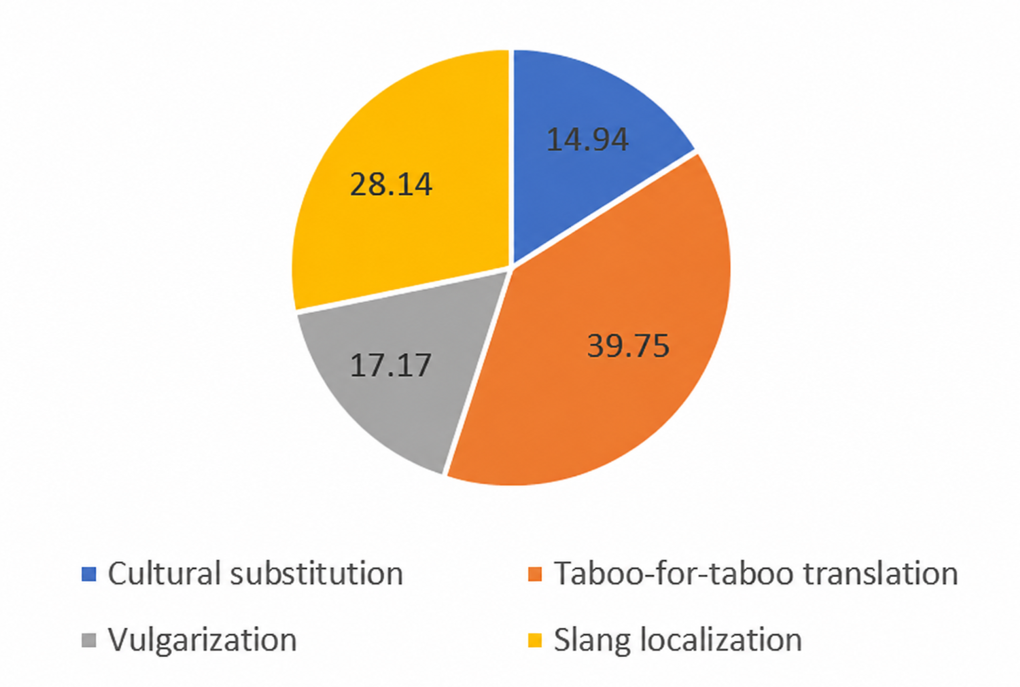
The distribution reveals several notable tendencies in the Romanian translation. The highest percentage corresponds to taboo-for-taboo translation (39.75%), indicating a clear tendency to maintain direct equivalence when rendering taboo expressions. This suggests that the translator generally opted to preserve the pragmatic force and expressive intensity of the ST rather than attenuate it. At the opposite end of the spectrum, cultural substitution has the lowest distribution (14.94%), which may indicate a certain reluctance to domesticate the ST. The limited use of this strategy also suggests that the translator preferred to preserve the ST’s original sociolinguistic texture, resorting to cultural substitution only when strictly necessary.
Each strategy serves not only to render meaning but also to preserve and, in some cases, amplify the construction of identity and the articulation of ideology that are central to the ST. Table 2 shows selected linguistic units from the ST and their corresponding translations. Each example demonstrates the application of a specific strategy and its pragmatic impact on the TT.
Table 2. Examples of translation strategies and their effect on the TT
|
Strategy |
ST example |
TT example |
Translation effect |
|
Taboo-for-taboo translation |
“You little motherfucker…” |
“Căcat-cu-ochi…” |
Equivalent level of offensiveness. |
|
Slang localization |
“The pimps out there…” |
“Peștii de-acolo…” |
Adaptation to a TT urban sociolect, maintaining authenticity. |
|
Vulgarization |
“Freak off all night…” |
“Te-ai frecangit…” |
Intensification of vulgar and creative tone. |
|
Cultural substitution |
“Four bits in the joint” |
“Patru porții de mititică” |
Enhancement of cultural proximity. |
The combination of strategies demonstrates a functional and pragmatic approach: the translator prioritizes maintaining identity markers and ideological positioning over formal equivalence. Whether through taboo for taboo, cultural substitution, vulgarization, or slang localization, the Romanian TT successfully transmits the linguistic aggressiveness, hierarchical awareness, and worldview of the ST. This correlation between translation strategy, identity, and ideology emphasizes the complex role of language in representing subcultural experience, highlighting how translation mediates not only meaning but also social dynamics and value systems across cultures.
Conclusions
The present study examined the role of marked language in shaping cultural identity and conveying ideological stances in Pimp: The Story of My Life, and how these features are rendered in the Romanian translation. An analysis of 629 examples demonstrated that the narrator’s voice relies on profanity and subcultural slang to construct identity, assert dominance, and articulate worldviews rooted in street culture, survival, and hierarchical social relations, all of which reflect complex social ideologies such as gendered control, racialized power, and subcultural codes of toughness.
Translation mediates the transfer of these ideologies by preserving the ST’s worldview while adapting culturally specific expressions. Each strategy not only renders meaning but also reproduces subcultural norms and authority dynamics, maintaining the narrative voice’s expressive and performative force. The findings highlight that translating highly marked language is a cultural and ideological negotiation, requiring careful balancing of fidelity, intelligibility, and pragmatic effect to ensure that the ST’s identity-driven and ideological functions are effectively reflected in the TT.