Introduction
Euskara is classified as a pre-Indo-European language. It was already in existence before the arrival of Indo-European languages into the geographical zone where it is spoken today. Furthermore, it is considered a linguistic isolate, unrelated to any other language in the world.1 Even so, it has not been considered a valuable source for knowledge about the way speakers may have related to each other and the world at large in times past, possibly even in the remote past. Nor has it been viewed as capable of shedding new light on how other languages like English operate. In this article I will argue that Euskara is a reservoir of clues concerning a cultural-linguistic schema comparable in certain senses to Bakhtin’s notions of dialogic addressivity and subjectivity (94–95). Whereas Bakhtin’s work focuses on dialogic addressivity at the level of discourse and the slovo (word or utterance), the Basque counterpart manifests itself in a set of mutually reinforcing linguistic features, structurally embedded in the language. When combined, these features reveal a cohesive, collaborative dialogic cognitive stance.
This point of view can be defined as a dialogic as opposed to a monologic linguacultural schema, the latter being a stance more deeply entrenched in languages like English and taken up by speakers unreflectively, that is, without them being aware of its existence or that this positionality is built into the very structures that English itself provides for the speaker. Even though English has been analyzed from many points of view, the fact that it contains, indeed, projects a more monologic positioning on speakers than occurs in Basque, has gone unnoticed until now because there has been no alternative dialogic positioning available for comparison.
According to Bakhtin, monologism is a single-voiced assertion that objectifies other voices, failing to recognize their individuality and unpredictable nature. Again, Bakhtin is talking about discourse and how speakers choose to utilize words—the way that an utterance is framed—not about the way that the morphosyntactic toolkit of a language positions speakers either monologically or dialogically vis-à-vis the real or implied “Other,” the interlocutor. More concretely, he is not speaking about the linguacultural schema that undergirds the morphosyntactically given positionality of the speaker in the language in question and which concerns us here.
Whereas Bakhtin’s term dialogic subjectivity is often used to refer to the way individuals express and negotiate their identities through narratives and interactions, here it will be used to refer to how aspects of language itself can act to frame subjectivity and hence selfhood. This shift in focus produces a definition of dialogic subjectivity that differs somewhat from that of Bakhtin, since his approach was oriented much more to exploring the way that speakers construct their identities through interaction with both themselves and others rather than on how language itself can predispose speakers toward certain frames of identity and therefore privilege one linguacultural schema of identity over another.
As is well known, schema theory states that schemas are learned or acquired over time from direct and indirect experience with the social environment. Through experience, speakers build up a large repertoire of cultural schemas that, in turn, set up general expectations concerning how the world is structured. They provide an organizing framework for one’s actions and understandings of the resulting worldview, that is, one’s intentional world (Sharifian). Quite obviously, language forms part of the social environment and therefore plays a major role in the acquisition of a given schema. Even though the processes by which the schema itself is acquired and cognitively entrenched are quite complex, language represents a locus where lexical and morphosyntactic instantiations of a given schema can reside, quite unobtrusively. Indeed, the speaker often acquires only an unreflective awareness of the schema along with its sociocultural implications. Stated differently, the speaker assimilates the schema without ever having to step back and define the way that it operates to shape the individual’s intentional world. And once acquired, schemas allow for pattern recognition.
Some cultural schemas have lexical and morphosyntactic extensions in language, such as those represented by the three linguistic features that will be analyzed here. As a result, they can function as cryptotypes in the Whorfian sense, hidden from the conscious awareness of the speakers of the language. A cryptotype “has no formal mark and whose meaning is not clearly evident, but is rather a submerged meaning shown as an influence […]” (Whorf 105). It contrasts with the phenotype, which is “the ‘classical’ morphological category, having a formal mark and a clearly apparent class-meaning. […] Linguistics up to now has studied almost entirely the phenotypes. Study of cryptotypes opens up a more psychological phase of linguistics” (105). To summarize, Whorf’s cryptotypes refer to covert categories in language, crucial for meaning and communication of conceptual frames of understanding, but that are not overtly marked. Furthermore, these covert categories can form analogical groupings and hence, working together, surreptitiously influence the speaker’s habitual thought processes.
Stated differently, speakers can assimilate a linguacultural schema such as dialogic or monologic subjectivity without ever having to step back and define the way that it operates to shape that individual’s intentional world. Once acquired, these schemas, although in essence submerged and not part of the speaker’s conscious awareness, allow for pattern recognition and can be translated into the accepted way of thought and (social) action. Moreover, the elements making up a complex linguacultural schema do not operate independently of each other but rather can represent a complex meshing of features whose functioning at the global level is often difficult to detect and/or assess, what Whorf has called analogical groupings (Lucy, Language Diversity 36–68). Moreover, in the Basque case until now these frames of understanding have not been elaborated upon by Basque linguists or philosophers. And the same holds true for English. Rather, these frames have operated inside both languages in a way quite similar to Whorf’s covert categories and cryptotypes. In the case of individuals “who have internalized the cryptotype its mode of operation is so far from conscious awareness that it is, in effect, an undercover or secret process–active but unmonitored and, indeed, almost unmonitorable as we speak and think” (Lee 173).
I would like to make an additional comment concerning the material covered in this study. While I have repeatedly spoken of cultural schemas and frames of understanding in reference to the Basque material (Frank, “A Cognitive Approach”), these conceptual entities are often held “covertly” by members of that speech community and I allege the same is true with respect to the linguistically instantiated English concept of monologic subjectivity. Therefore, the resulting conceptual frames are also related to what Whorf has called the psycholinguistic patterning of a language and the covert categories of thought that inform it (Lee 161–192). The dialogic subjectivity discussed here in relation to the Basque concept of selfhood manifests itself across the language and culture in a heterogeneously diffused fashion. Similarly, its monologic counterpart in English is equally subtle in the way that it is instantiated in language and apprehended by speakers.
To illustrate the differences between the two types of subjectivity three linguistic features will be brought forward for comparison. The first contrasts an aspect of the English and Basque demonstrative systems. Even though demonstratives play an important role in any language, little attention has been paid to how they contribute to the monologic or dialogic subjectivity of the language in question. This is a topic that, to my knowledge, has not been taken up in the extensive literature on deixis (Anderson and Keenan; Diessel, Demonstratives, “Distance,” “Pronominal,” “Morphosyntax;” Lenz). As a result, no attempts have been made to correlate the types of subjectivity implicit in the demonstrative system with other linguistic features and habitual modes of expression found in the language.
The second feature to be studied consists of a set of contrasting fixed expressions found in each language. The two sets of expressions, when compared, become examples of the distinctive type of linguistically conditioned habitual thought also reflected in the two contrasting demonstrative systems. The cognitive structure of each set of fixed expressions can be analogized to the patterns of the linguistic model provided by the demonstratives. The third example discussed is drawn from Basque, namely, allocutivity, a feature by means of which the gender of the addressee is encoded for morphosyntactically, even though the addressee is not an argument of the verb. This feature has no contrasting counterpart in English. However, the cognitive thought patterns implicit in the Basque feature are easily analogized to the structure of the first two Basque examples, revealing how together they mutually reinforce each other, lending support to the same concept of dialogic subjectivity. As a result, we will see that the absence of the third feature in English can be taken as further proof of the differences between the two languages and highlights how the associated linguistic analogies, albeit covertly expressed, have framed the models available to the speakers of each language.
Comparing Demonstrative Systems
First off, it is worth noting that the demonstrative system of English is not structured in the same way as the Basque system. It does not have the cognitive mechanisms built into it that, as is the case in Basque, make it possible to contextualize the interaction between speaker and interlocutor within the discursive act itself. At first glance, the difference might be explained by the fact that the English system is made up of only two elements, this and that, whereas the Basque system has three elements. But the differences go deeper.
Three-part demonstrative systems are regularly divided into two classes, based on whether they are viewed as distance-oriented or person-oriented, both of which are, ultimately, defined spatially in most of the literature on this subject (Anderson and Keenan; Diessel, “Distance”). If the system is considered distance-oriented, all demonstratives are said to indicate the relative distance between the referent and the deictic center or origo which is the speaker.2 On the other hand, if they are person-oriented, one of the demonstratives is said to denote a referent in “the proximity of the hearer.” Generally speaking, person-oriented systems set up three areas: near the speaker, near the listener and far from both.3 However, as will be demonstrated, the angle of vision in the discussion of distance-oriented systems as well as person-oriented ones focuses on spatial distance, and in this sense only on the deictic employment of the demonstrative itself in which spatial coordinates are what dominate. In what follows, we will see that this definition is insufficient when it comes to explaining how Basque demonstratives function, as well as how the English two-part this and that demonstrative system is employed, especially this, a point we will return to shortly.
As currently understood in the literature on this subject, in a purely distance-oriented system composed of only two demonstratives, the role played by the listener is non-existent: it is not marked. The space near the speaker and the space away from the speaker are referenced. In a three-part distance-oriented system, the three spaces are referred to using the terms proximate, medial and distal. Moreover, the same three spatially defined terms are also regularly employed when describing a person-oriented system and in such descriptions, the hearer simply occupies the medial exophoric physical location. Thus, because of the terminology used, the interlocutor in a person-oriented demonstrative system is portrayed as having no other role or affective relationship with the speaker. As will soon become apparent, this is not the case with the Basque person-oriented system.
When discussion of the English and Basque demonstratives takes place in English, the conceptual baggage of the system of demonstratives of the native or preferred language of the reader, that is, English, tends to take over, obscuring what is going on in Basque. Whereas the writer is forced to draw on the demonstrative system of the language of translation, clarification must be made indicating that the spatial deixis implicit in demonstratives like this and that in English does not correspond to the spatial coordinates and complex expressive applications of the Basque demonstratives. Unless the differences are carefully explained, this causes readers to unconsciously import the coordinates and conceptual frames of reference attached the demonstrative system with which they are familiar, i.e., that of English, and apply it, erroneously, as an interpretive grid.
If not explicitly countered, we are confronted with the cognitively distorting role of what Lucy (“Systems” 333) has called translation projection: the way readers tend to project or import, although often in an unconscious and therefore indiscriminate manner, the cognitive models implicit not in the language in which the text was originally written, but in the language into which the text is being translated. The models of the second language are superimposed on the original text. And this to a certain extent is both a logical and quite inevitable result: the translator is bound by the linguistic norms and frames of understanding of the language into which the text is being translated. This, however, should not be the case when a linguist attempts to compare two languages, especially two languages whose demonstrative systems are structurally very different.
In other words, because of the way that terminology on this topic has been conceptualized, no emphasis has been given to the notion of dialogic as opposed to monologic addressivity and the corresponding cultural schemas of dialogic and monologic subjectivity. In the former case the interaction between the speaker and the interlocutor is foregrounded by means of one or more of the demonstratives. This relationship is not merely deictic in the sense of setting up physical locations in space, e.g., near the hearer, but rather is an example of the expressive employment often associated with three-term demonstratives, but not exclusively (Naruoka, Expressivity, “Toward meanings”). In the case of monologic subjectivity, the role played by the addressee is absent, even though all exchanges, even in soliloquy, have both a speaker and an implied listener. In soliloquy or what is often called monologue, there is still a listener, i.e., oneself.
The three-part Basque demonstrative system has two faces: one deictic and the other expressive.4 Although these two aspects can be categorized conceptually as separate usages, in practice they often overlap and intertwine. Therefore, they can be difficult to fully separate. As noted, the term deictic refers to the location of the entity in physical space. In Basque the exophoric usage of the first-grade demonstrative hau refers to the space near the speaker, the second-grade demonstrative hori highlights the space near the hearer while the third-grade demonstrative hura denotes a space distant from both the speaker and addressee (de Rijk, Standard Basque 205).
In this respect, in Basque the relationship between the three demonstratives and person is relatively clear. For this reason, to refer to them using the terms proximate, medial and distant misconstrues what is going on and is, therefore, a misnomer. Indeed, when concentrating on their physical deictic extensions, the spaces could be conceptualized as projecting first-person, second-person and third-person locations, i.e., near the speaker, near the interlocutor and distant from both. However, in order not to cause confusion, here we will refer to them as first-grade, second-grade and third-grade demonstratives following the standard practice in Basque.
When the Basque demonstratives are used expressively, the space in question is not physical but rather mental. For instance, when used expressively, the first-grade demonstrative hau can situate the entity so that it is as if the speaker and interlocutor were viewing it from the same perspective, as if they were standing side by side, sharing the same vantage point. This “we” space can also confer a sense of solidarity, shared concern and emotional attachment on the part of the speaker and listener with respect to the entity, object or concept under focus. In other words, referring to an entity using the first-grade demonstrative hau can situate the entity in the shared mental space of the speaker and interlocutor, the “we” space.
This usage has left a deep imprint in the language, concretely, in what is referred to by Basque linguists as the “proximate plural” (urbila), from -ok (hauek > (h)ok). However, this proximate plural, rather than being a unique kind of plural, is nothing more than the traditional expressive application of the first-grade demonstrative to carve out a “we” space and establish a shared perspective (Martínez Areta 245; Zubiri and Zubiri 306). What has been missing in discussions by linguists of this expressive usage is the fact that the singular form of the first-person demonstrative can carry the same force and indicate that the speaker and addressee identify in some way with the entity in focus. To summarize, this expressive function of the first-grade demonstrative is another example of how the role played by the addressee is subtly alluded to, covertly, by means of what Whorf would have surely called a cryptotype.
Before leaving this topic, I want to shift gears and turn to a lesser studied aspect of the English demonstratives which will help to further illustrate what goes on when the first-grade Basque demonstratives are used to set up a shared mental space and, therefore, common perspective. The English demonstratives this and that are said to express a simple distance contrast, this for near the speaker and that for away from the speaker, although at times that can also express a spatial location near the addressee: This is my pen and that one is yours. When viewed from this angle, the English system would appear to have only deictic applications and no expressive ones. However, a closer examination of actual usage reveals that things are a bit more complicated and that we might even speak of the presence of applications that are more in line with the dialogic addressivity and subjectivity associated with the Basque system.
The following snippet will illustrate my point: “I was about to sit down when I see this man running toward me with his arms outstretched. A few feet from me, he stops and with a puzzled look on his face, he says ….” This sequence is characterized by what Hanks has called a shift in the indexical ground. The shift is also accompanied by a switch from past to present tense and, therefore, the use of the historic present to narrate a past event. Initially, the listener is positioned externally, situated as an outside observer (and not participating in the event). But when the speaker says “when I see this man…” instead of “when I saw a man…,” the shift in the indexical ground is obvious. I would argue that the choice of this man as opposed to a man brings the addressee into the picture, as if that person were contemplating the scene from the same perspective as the speaker. The listener is now on the inside, watching the events unfold alongside the speaker.
In these instances, the use of the historic present only adds to this impression of immediateness (Naruoka, Expressivity 95-126). The shift in the indexical ground and the accompanying covert incorporation of the addressee in the English example is analogous to what goes on with the Basque first-grade demonstrative when it is used to align the speaker’s perspective with that of the (implied) interlocutor. In summary, I believe we could argue that there is an expressive aspect to the English demonstrative system, not as pronounced and elaborated upon as the expressive functions inherent to the Basque one, but still available to speakers and listeners alike. Consequently, in English there is a hint of dialogic addressivity.
Returning to the expressive meanings conferred by each of the Basque demonstratives, the adnominal use of second-grade demonstrative hori can offer up the entity for contemplation by the interlocutor. In other contexts, hori can be used to refer directly to one’s interlocutor, for example in the question posed by the speaker in the lyrics of a well-known folk song, Maritxu, nora zoaz eder galant hori?, ‘Maritxu, where are you, pretty and elegant, going?’ Or it can be used to allude to the person you are talking to: Alper hori! ‘You loser!’ As a further clarification of this use, we have the fact that the first-grade demonstrative (h)au can also be employed to refer to the speaker as well as functioning as a suffix to form intensive forms of the first-grade pronoun ni ‘I’, while the same holds for the second-grade demonstrative (h)ori, employed to create emphatic forms of the second person pronouns, hi and zu (Azkarate and Altuna 11–28). The expressiveness inherent in the Basque demonstratives, especially the way the first-grade and second-grade demonstratives function, sets them off from what regularly goes on in the case of the two English demonstratives. Here we also need to remember that since Basque has no third-person person pronouns and no gender, the demonstratives also play the role of the English pronouns he, she, it and their plurals.
Keeping in mind these three-tiered demonstratives, to refer to an entity using the first-grade demonstrative hau expressively can situate the referent in the shared mental space of the speaker and interlocutor, the “we” space and, accordingly, project a shared perspective. In contrast, as has been noted, when used deictically, the third-grade demonstrative refers to a location distant from both the speaker and interlocutor. But when used expressively, it points to an entity that is familiar to both the speaker and listener, common knowledge or something that has been referred to previously in discourse.5 When compared to what goes on in English, the expressive meanings conveyed by Basque third-grade demonstrative, historically (h)a(r) or simply a (as is still the case in the Bizkaian dialect) coincide to a certain degree with the work done by definite and indefinite articles in English.
To conclude, the differences between the demonstrative systems of English and Basque raise the following interrelated questions. First, we might ask to what extent the linguistically transmitted patterns of each system have acted to shape the habitual thought world of the speakers, that is, to what degree they have served as guides for habitual cognitive activity. Next, we have the question of the extent to which the language patterns inherent in the demonstrative system of each language have been shaped by preexisting extra-linguistic cultural patterns of behavior and thought. Although there are no clear answers to these questions, a comparative analysis of the two demonstrative systems reveals two distinctive and highly entrenched cultural-linguistic schemas. And these schemas, in turn, may well have been incorporated into both linguistic and social practice and hence subtly impacted the habitual thought and worldview of the speakers, albeit in a covert fashion.
Further Evidence of Dialogic and Monologic Subjectivity. Contrastive Sets
In this section we will compare the conceptual positioning of four expressions found in Basque and their English counterparts. As stated previously, in Euskara there is a bundle of intertwined, mutually reinforcing features that, taken collectively, serve to highlight the notion of dialogic subjectivity as that term has been defined in this study. When contrasted with the English examples, the Basque expressions listed below capture the action sequence in such a way that attention is consistently oriented toward the implied other, away from the speaker. In English the opposite is true: the origo is the speaker and the action sequence starts out oriented toward the speaker, not the implied other.
Table 1. Contrasting examples of dialogic and monologic subjectivity
|
Basque Expression |
English gloss |
English Expression |
|
han hemenka |
‘there and here’ |
here and there |
|
joan-etorriak |
‘go and come’ |
come and go |
|
sal-erosi |
‘sell and buy’ |
buy and sell |
|
harr-emanak |
‘take and give’ |
give and take |
Before we analyze the possible significance of the contrasting sets in Table 1, a few comments are in order concerning the composition and meaning of the Basque items. In the case of han hemenka, the second element of the two adverbial expressions, han ‘there’ and hemen ‘here,’ has the ending -ka attached to it, an iterative affix which acts to reiterate the concept or action of the base and therefore is often conceptualized as a kind of gerundive affixing element. In this case, the expression han hemenka could be translated, literally, as ‘(around) there-here.’ The following three examples are constructed on verbal bases that have been nominalized. Hence, the nominalized plural version of joan ‘to go’ combined with etorri ‘to come’ could be translated, literally, as ‘going-comings.’ And the same holds for sal(du) ‘to sell’ and erosi ‘to buy,’ where the compound translates literally as ‘selling-buyings.’ Here the exchange is initiated by the act of selling, not buying. These two verbal forms can be further nominalized into salerosketa with the addition of the -keta suffix, which allows the action in question to be expressed more globally, literally, the ‘act of selling-buying.’ It becomes a locution that would translate into English as ‘buying and selling, commerce, business.’ Similarly, har(tu) ‘to take’ and eman ‘to give’ are utilized to form the compound expression harremanak, which translates into English as ‘relations, relationship,’ as in human relations. The compound, when translated literally, becomes the ‘taking-givings.’
When contrasted with the English examples, the four Basque expressions listed appear to capture the action sequence in such a way that attention is consistently oriented toward the implied other, away from the speaker and therefore, we could say, toward the interlocutor. Nevertheless, at first glance the English example give and take might seem to contradict this general rule. Moreover, this initial impression is further reinforced when one views the Basque expression harremanak, which conveys the notion of ‘relations, dealings, relationships’ and where the notion of ‘taking’ is foregrounded. Hence, the Basque example might appear to be more speaker-oriented than the English example since the initial action is ‘to take,’ followed by ‘to give.’ However, the notion that is being described in Basque has to do with how one deals with others and, therefore, the notion of reciprocity. By setting up a scenario where the first action is ‘taking from the other,’ one is obliged to ‘give back.’ In this sense, the action of ‘taking (from)’ is still oriented toward the interlocutor. In English, the opposite is true: it is the speaker who gives.
Consequently, we might say that in the English frame, this initial action is what sets in motion the obligation to give back, an obligation that then resides with the interlocutor. While the notion of reciprocity implicit in Basque expressions such as harremanak might seem somewhat peripheral to the larger issue of the way that reciprocity is encoded culturally and elaborated upon intersubjectively in Basque society, studies point to the fact that this cultural schema is deeply entrenched and penetrates many aspects of traditional Basque culture and society (Hess and Arregi). Therefore, expressions such as harremanak are linguistically congruent with the cultural norms associated with the concept of reciprocity and the importance given to maintaining balanced relations among members of the social collective who are viewed as equals.6
Once again, the ego-orientation embedded in these expressions is quite apparent. They act as mini-narratives, cultural scripts that frame and guide human action (Shore, Culture in Mind, “Twice-born”). Not only do they frame the exchanges in a particular way, either as monologic or dialogic, they have a prescriptive force attached to them even when it is not apprehended in a conscious fashion. Viewed as cultural scripts, they portray the way that social interactions should be structured. In this sense, they do more than describe the actions in question; they license a particular way of perceiving such interactions and, consequently, subtly act to teach speakers about how they are to behave. In the English version of these scripts, we find that rather than considering first an action directed toward the interlocutor or implied other (or toward what benefits the other), it is the speaker-oriented action that is foregrounded—an action that could be viewed as favoring or even privileging the speaker.
Moreover, it would not be difficult to argue that in Basque the mini-scripts of this set constitute another manifestation of dialogic subjectivity and resonate with the conceptual frame intrinsic to the three-part demonstrative system. In the case of the English expressions, what is striking is the consistency with which they are in alignment with each other and, consequently, contrast with the Basque examples. Thus, it is tempting to interpret these English examples as another facet of the more monologic stance of English when compared to Basque: the linguistically encoded monologic addressivity of English is highlighted.
In summary, the cultural script instantiated in the Basque examples demonstrates a consistent relational orientation, more congruent with the concept of dialogic rather than monologic subjectivity, while the opposite is true of the English expressions. Hence, these English and Basque datasets can be viewed as entrenched linguistic instantiations of two contrasting concepts of self and ways of interacting. Since these are fixed expressions, neither the Basque speaker nor the English one is consciously aware of the fact that there is positioning embedded in each of the utterances. They tell a story that sets forth an approved pattern of intersubjective action, albeit a very different one in each case. In short, speakers are not cognizant of the role played by their utterances. They do not notice that using the expression positions them in a specific way vis-à-vis the implied other. Nor do they realize that by reproducing the expressions the already linguistically sanctioned positioning is further reinforced whether it be monologic or dialogic. Thus, it is safe to say that in both instances we are dealing with what Whorf referred to as a covert category or cryptotype. At the same time, these contrasting examples are further proof of the importance and meaning of Bakhtin’s term dialogic addressivity. In sum, the historically entrenched cultural scripts found in each language, when taken as a whole, argue in favor of the interdependence of language, cognition and social action along with the important role played by covert categories in the composition of such a worldview (Głaz).
Dialogic Subjectivity and Allocutivity
Allocutivity, a term coined by Louis-Lucien Bonaparte (19–21), is used to describe a phenomenon which exists in all Basque dialects. Moreover, to my knowledge, the specific linguistic features characterizing the Basque system have not been recorded in any other language. In recent years attempts have been made to broaden the definition of allocutivity (Antonov) so that it includes politeness morphemes and honorifics, for example, as in Japanese and Korean. But there has been no success in finding another language with the type of natural gender-linked allocutivity identified in Euskara. While other types have been studied, it is the Basque example that has received the most attention. But that attention has, for the most part, concentrated on formal syntactic aspects of this feature (Haddican and Etxeberria) rather than cognitive or cultural ones and more specifically the way that allocutivity reinforces the linguacultural schema of dialogic subjectivity characterizing the Basque language.
Briefly explained, the term allocutivity refers to the form of address required when the speaker uses the hika verbal register of address as opposed to the non-allocutive zuka register, hi and zu being two second-person pronouns. With hika the addressee is systematically embedded in all the main clause conjugated verb forms of declarative sentences, even when the addressee is not an argument of the verb. For instance, when telling a story about a third party your interlocutor’s presence is encoded verbally. Moreover, although Basque is a language with no grammatical gender, allocutive verb forms require the speaker to mark the gender of the person being spoken to in the verb itself. For example, in a sentence with a direct and indirect object, such as “the girl gave it to him,” the use of the hika register requires a third element to be added to the verb itself, an element that marks the gender of the addressee.
In this brief essay I can only provide the reader with a broad overview of the hika register itself, its development over time and its current status. For a fully fleshed out description I recommend reading Alberdi Larizgoitia’s readily accessible English language study published in Pragmatics. The following examples are adapted from his work:
a. Ni polita naiz
I beautiful am
“I am beautiful” [“default” or “neutral” mode of address]
b. Ni polita n-au-k
I beautiful am
“I am beautiful” [hika register addressed to a man, -k marking the masculine]
c. Ni polita n-au-n
I beautiful am
“I am beautiful” [hika register addressed to a woman, -n marking the feminine]
d. Ni polita n-au-zu
I-A beautiful am
“I am beautiful” [allocutive zu register, plural addressee, unmarked for gender]
Although in some Romance languages such as French and Galician allocutive dative clitics (Je TE lui ai écrit une note) may be used as relatively marked forms (Oyharçabal), Alberdi Larizgoitia (314) points out that “it is up to the speaker to use the dative clitic; in other words, it is not compulsory. In Basque, in contrast, allocutive agreement is required by the pronoun selected (and the dialect).” Hence, the first example cited above (without any allocutive agreement) would be unacceptable to an addressee who previously had been assigned the hi mode of address. In short, the hika register has obligatory allocutive agreement, where its verbal morphology represents the gender of a non-argument addressee.
Over the centuries the use of hika register has been on the wane and the unmarked (neutral) zuka form of address has now become the only register used today by many speakers in urban and semi-urban environments. Even so, in recent years valiant efforts have been made to keep the hika form of address alive. Given that the hika forms refer to a singular addressee, there were corresponding allocutive forms for plural interlocutors, based on the plural pronoun zu. This is still the case in the northeastern Low Navarrese and Zuberoan dialects (Rebuschi). Today those plural allocutive forms have been overridden in other zones by the neutral non-allocutive zuka forms in which the pronoun zu is portrayed as singular. As Alberdi Larizgoitia (307) has stated, everything suggests that the present-day singular non-allocutive zu form was originally a plural that subsequently underwent a development not unlike what has happened in Spanish and French, as well many other Indo-European languages (Joseph).
Whereas in the literature on this subject, the hika forms are often referred to as “familiar” and zuka forms as “polite” or “formal,” that characterization fails to capture the complexity of what goes on in the language. It is, instead, constructed through a mistaken analogy with the Spanish “familiar” (tú) and “polite” (Ud.) forms of verbal address or their French counterparts. Accordingly, there are Basque linguists who counter this terminology arguing that speakers who use the hika forms view them rather as expressing “comradeship” (Azkue 433), “solidarity” (de Rijk, “Familiarity or Equality;” Standard Basque 111–13, 621–22) and/or that the speaker and addressee are understood to be “equals” (Bittor Hidalgo, Personal interview concerning the use of hika “Hiketari buruzko elkarrizketa,” December 3, 1982).
After describing the current uses of the hika register, de Rijk goes on to make this comment:
Against this backdrop it is fair to conclude that the traditional conception of zu as a polite form and hi as a familiar form is far from adequate, if only for the reason that it suggests more conformity with the neighboring Romance practices than is in fact that case. In this grammar, therefore, an altogether different characterization is being proposed. Our advice to the reader is to view zu as the normal, pragmatically unmarked, form of address, and hi as a marked substitute, encoding the feature of “Solidarity” as it is defined by the social realities of local Basque culture. (Standard 112)
The conflation of the hika forms with the “familiar” treatment of address in French and Spanish is common in much of the work written on this subject, even when the rest of the description of the usage is perfectly accurate, as in the following citation:
It is important to note that sentences containing allocutive forms have exactly the same meaning as the corresponding ‘plain’ sentences regarding both prepositional content and information structure. Allocutivity is different from the so-called ‘ethical dative’ of some Romance languages, where the use of the second person dative marker indicates that the addressee is somehow affected or interested in the proposition. The use of allocutive forms does not convey any such meaning. It is simply an obligatory feature of the familiar treatment. If the addressee is treated as hi-, every verb in a main clause must contain allocutive morphology. (Hualde and Ortiz de Urbina 243; emphasis added)
Whereas Azkue and de Rijk, as well as other Basque linguists (Basterretxea Santiso 231–232), might not agree with the wholesale appropriation of the opposing terms of “familiar” versus “polite” or “formal” to describe the opposition between the allocutive hika and the neutral zuka registers, Martínez Areta repeatedly uses these same two terms with only this caveat: he states that “[i]n the varieties where hika is used, the scope of hi is more restricted than the French tutoiement, and much more so than the Spanish tuteo” (301). Apparently either for convenience or lack of feedback from informants, Rebuschi also chooses the term tutoiement in his research and, consequently, implies that the same categories of “familiar” and “polite” found in Romance languages exist and existed previously in Basque.
Conflating what goes on in Basque with what goes on and went on in the two Romance languages might be written off as merely a convenient analogy. But the repeated employment of these two terms in the literature on this subject fails to capture what happens in the Basque language and by extension in Basque society. Indeed, the terms distort the underlying social and cultural realities along with the associated and well documented commitment to egalitarianism (Hess and Arregi). “The sociolinguistic variables and social patterns governing the use of forms of address in Basque clearly differ from those observed in Spanish or French and are not apparently influenced by them” (Alberdi Larizgoitia 315).
Hence, we might say that through the repeated use of the two Romance terms linguists superimpose a set of historical realities consistent with what happened in France and Spain but not readily applicable to the Basque case. These are realities—power relations—that in France and Spain translated over time into two types of address. Their evolution reflects changes in the sociocultural structure of France and Spain, modifications that eventually gave rise to two forms of address that linguistically marked the existing social inequalities and instantiated them in linguistic practice. Consequently, by employing the terms familiar and polite to describe what goes on in Basque the historical sociocultural situatedness of the Basque forms of address is erased. Moreover, we need to remember that when viewed diachronically, in times past the only option available for speakers when referencing a single addressee would have been the hika register and when faced with a plural addressee the alternative would have been the allocutive zuka forms.
In the work that has been done on allocutivity there are two problems that crop up constantly. The first has to do with the terminology utilized by many researchers who repeatedly refer to the hika usage as “familiar,” while zuka is called “formal” or “polite,” an analogy, as noted, drawn from the two usages in Spanish and French. That terminological choice obscures what goes on in Euskara and instead is constructed on the basis of typical power relations and inequality that lead to two forms of address, in an up-down fashion (Brown and Gilman), and in which, as a result, the individual in the inferior position addresses her superior with the “formal” verb form while the latter is free to address that interlocutor with the inferior “familiar” verb form. The use of the terms familiar and polite to describe what goes on in Basque implies that a societal sanctioned inequality of power gave rise to asymmetrical forms of address: one-sided hi downward from above and one-sided zu upward from below. But this type of imbalance and, consequently, veiled expression of asymmetric power relations rarely occurs in the way the two forms of Basque address are actually utilized.
For instance, according to de Rijk
[a]ctually, in view of the firmly egalitarian ethic of traditional Basque society, such asymmetry is, in my experience, quite rare. Even between employer and employee mutual zu prevails, or, more rarely, mutual hi. Only within the family context does the power dimension play a significant role: parents will address their teen-age children with hi, but not vice versa. (“Familiary or Solidarity” 376)
However, things are not that clear-cut because young children are addressed by their parents with zu and respond to them using zu. Meanwhile husbands and wives address each other using zuka forms. Similarly, when the relationship between a young man and woman becomes serious, they switch from hika to zuka.
The second problem has to do with the lack of recognition that when viewed diachronically, there is no doubt that in times past the allocutive forms were the only ones available to speakers and dialogic subjectivity was the norm. This means that the social domains of usage carved out by Basque speakers for the allocutive and neutral verb forms and discussed today by Basque linguists represent overlays on an earlier template and reflect modifications in a much older linguistically conveyed social practice. And this process was one that developed in a culture dominated by orality and hence face-to-face interactions. All of this helps to explain the significant variety in the social values attributed to the use of the hika and zuka registers today (Alberdi Larizgoitia 324–325).
As mentioned, when viewed diachronically, the only option originally available for speakers when referencing a single addressee was the hika register, while the allocutive zuka forms were employed for plural addressees. In other words, since there was initially only one register available—the allocutive one—the variety of usages of hi and non-allocutive zu found in today’s speech have been superimposed on that older practice. Therefore, the differences identified in terms of how the two terms are now utilized, the contexts in which they are employed, demonstrate the socio-cultural connotations and understanding the two registers have acquired over time, e.g., the use of hi to mark “solidarity” between “equals.”
In addition, any review of the extensive literature on this subject will show that, unfortunately, the role played by the linguacultural schema of dialogic subjectivity never comes into focus, namely, the way that the self is constituted by this allocutivity. Rather than portraying oneself as standing alone and, therefore, assuming a monological stance vis-à-vis the implied or real addressee of the utterance, the hika register requires the speaker to mark the presence of the “Other.” Indeed, from this vantage point there is no such thing as a monologue if it is defined as having no (implied) addressee. When employing the hika register, even in a soliloquy, the speaker refers to himself or herself using the corresponding masculine or feminine form. But curiously, when thinking introspectively, that is, without regarding themselves as the addressee, speakers of either sex tend to use masculine allocutive forms.
Allocutivity is a clear example of how the notions of dialogic addressivity and dialogic subjectivity can become interwoven and how they serve to express this linguistically instantiated cultural schema. In this instance, we are not talking about a fully submerged covert category or cryptotype, but rather a cultural schema that carries overt marking on the verb and that, therefore, also has implications for how individuals interact with each other. The larger question, one that cannot be treated here, is to what degree this linguistically entrenched dialogic subjectivity has a counterpart in social practice. And that question is linked to another one, equally complex and two-headed. The question breaks down into two parts: (1) to what extent, for example, did the hika forms contribute to socio-cultural expressions of dialogical subjectivity, and (2) to what degree did the social practices—the sociocultural extensions of this linguistically encoded, allocutively expressed addressivity—serve to perpetuate an understanding of human subjectivity as fundamentally dialogic. At the same time, we might ask whether the weakening of elements within this interlocking whole, such as the gradual process of the loss of allocutive forms in certain varieties of Euskara, has a counterpart in social practice and interaction. In short, we are dealing with a case of circular causality where two interlocking and mutually reinforcing elements operate.
Before concluding this discussion, there is one other point I would like to make. And to do so I need to return to the previous allegation that Basque is characterized by more dialogic subjectivity than English. Although there is no question the hika forms are linked to and encode the concept of dialogic subjectivity, we also cannot deny the fact that the non-allocutive zuka forms that developed over time represent an intrusion of monologic subjectivity. Whereas the type of addressivity conveyed by allocutivity is unquestionably dialogic, that of the non-allocutive zuka register is clearly monologic in that it is no longer obligatory to mark the presence and identity of the addressee(s). In short, today the verbal address registers linked to the singular pronouns hi and zu fall into two different and, in a certain sense, opposing categories, one dialogic and another monologic. Furthermore, if the number of speakers utilizing the hika register continues to diminish, in the future the monologic stance coded into the zuka register will become the only option available to speakers.
Final observations
As we have seen, unlike English, Basque has a series of linguistic strategies cognitively linked to the linguacultural schema of dialogic subjectivity. It is a relational schema that exists culturally and linguistically. Furthermore, it has been investigated from various angles, always focusing on the way in which this cultural conceptualization is manifested linguistically (Frank, “Body and Mind,” “Looking at Europe,” “Shifting Identities, Comparative,” “Shifting Identities, Metaphorics”). The scheme of dialogic subjectivity stands in opposition to monological subjectivity. It is linked to a concept that the Basque artist Alex Carrascosa has called elkarrekiko nortasuna, a term that is difficult to render in English. Whereas nortasuna translates rather seamlessly into English as subjectivity or selfhood, grasping the meaning of ekarrekiko (elkarr-eki-ko-ta-sun-a) is more complicated. It is based on elkar which could be defined as a reciprocal pronoun, ‘one-to-the other, together,’ or as an anaphoric pronoun with a referent that must necessarily be a plural or a coordinated nominal phrase. Consequently, the compound expression elkarrekiko nortasuna might be construed as ‘the duality of subjectivity’ or perhaps better stated ‘the reciprocity inherent in human subjectivity,’ while the sociocultural framework itself is expressed as elkarrekikotasuna.
For Carrascosa, this concept is a fundamental component of Basque culture. He sees it as a deeply entrenched cultural schema that, functioning like a cultural keyword (Levisen and Waters), is difficult to translate. As such, it has highly complex and tightly interwoven linguistic and cultural extensions, manifestations whose meanings are often submerged. Rather than being expressed overtly in the language, their meanings are often communicated surreptitiously by hitching a ride inside cryptotypes, and, therefore, operating just outside the conscious awareness of the speaker.
Carrascosa’s reflection on this cultural space can equally be applied to the interactive space established using the Basque demonstratives and is therefore a core cognitive component of the cultural linguistic system—the linguacultural system—we are describing. Carrascosa describes this conceptual space as “hala nola elkarrekikotasuna, osagarritasuna edo ‘transdualitatea’ (aurkakoen arteko ‘zeharkakotasuna’) eta dualtasunaz haraindi, une-gune biribil, dialogiko, harremanezko eta partehartzailea,” which translated into English becomes: a space “such as reciprocity, complementarity or ‘transduality’ (‘transversality’ between opposites) and beyond duality, a circular, dialogical, relational and participatory moment-space” (Carrascosa, personal interview, 20 March 2010).
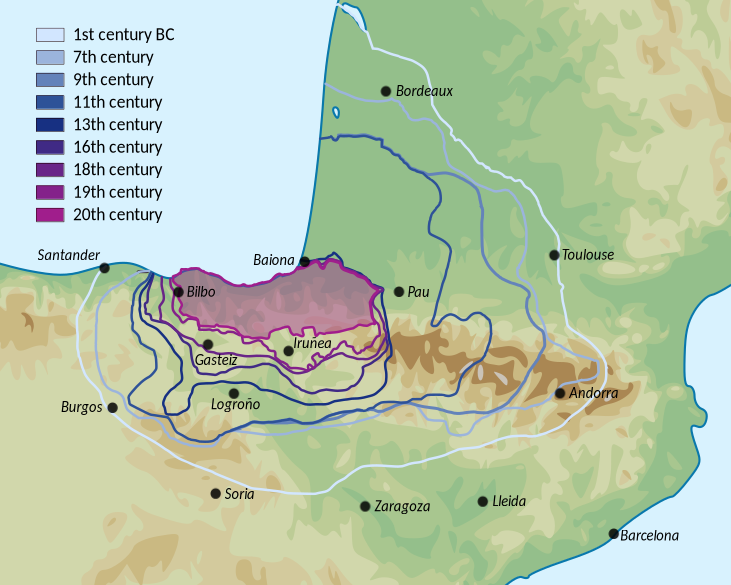
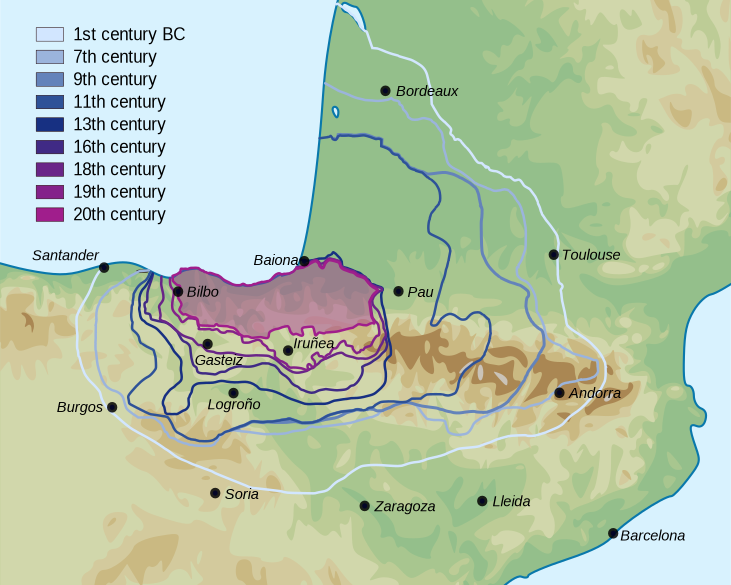
Finally, in addition to the role played by elkarrekikotasuna, there is an even more intriguing question to be explored, but one with no definitive answer. Until now all sorts of explanations have been brought forward to explain why this pre-Indo-European language has survived, arguments such as the ones based on the alleged geographic isolation of the Basques—the Pyrenees being posited as a barrier. That argument, however, is an extremely weak one for several reasons, most especially when we keep in mind that the language was spoken earlier not just in the heart of the Pyrenees, but much further to the north and south and east and west. Moreover, there is no way of knowing to what extent, even earlier, dialects of Basque were spoken over a much larger geographical area (Figure 1).
Figure 1. The postulated retreat of the Basque language over the past 2000 years. Source: Assar, based on https://commons.wikimedia.org/wiki/File:Euskararen_atzerakada1.svg

CC BY-SA 4.0 <https://creativecommons.org/licenses/by-sa/4.0>, via Wikimedia Commons
Among the various possible justifications for its survival there is one that, to my knowledge, has never been formulated. And it is linked to the contents of this article. In my opinion, it would not be too far-fetched to argue that the dialogic subjectivity and related addressivity built into the Basque language and culture may have played some role in ensuring its continuity across time. At the same time, I recognize that it can be risky to extrapolate from just a few examples to the broader cultural-linguistic schema under analysis, e.g., from the Basque cultural scripts represented by the three features treated (demonstratives, a set of fixed expressions and allocutivity). Yet, taken together they demonstrate a relational orientation that is more congruent with the concept of dialogic rather than monologic subjectivity.
On the other hand, the corresponding English features as exemplified by the English demonstrative system and the set of English expressions analyzed here align more closely with monologic subjectivity. Nevertheless, hints of dialogic subjectivity can be detected in the expressive use of the English demonstrative this. Meanwhile, in the Basque examples we have seen how inroads have been made by the schema of monologic subjectivity. This is especially true with respect to the increasingly restricted use of the hika register in urban and semi-urban settings as well as by euskaldun berriak (‘new Basque speakers’), whose exposure to the language tends to be limited to the unified Batua standard. To conclude the English and Basque examples can be viewed as entrenched linguistic instantiations of two opposing concepts of self, one relatively monologic and the other more dialogic, while, as has been noted, the associated cultural scripts in each language, taken as a whole, argue in favor of the interdependence of language, cognition and social action in the formation of worldviews.